Prioritizing Tasks and Managing Deadlines

Sometimes it feels impossible to fit everything in that you want/need to get done in life.  I feel that way almost every day.  I am married with three young, energetic boys and I work from home as a grant accountant and have since 2018.  I also have a side job that I work on a few evenings a week.  Life is busy and hectic almost always; there is constant competition for my attention. Prioritizing has certainly become an essential way of life for me.

I work for a very fast-paced non-profit organization that is growing like crazy.  We are continuously adding more agreements with more agencies and are all pitching in as we look to expand our workforce to meet this growth. This can certainly feel stretching at times, but I have learned a few things that have helped me tremendously in my work and personal life.

Take Time to Plan
Taking time for planning is the first essential to managing all that work and life throws at you.  When you are “drinking from a fire hose,” planning does not seem as important as just doing the next thing to keep afloat. From my personal experience, however, this just leads to spinning your wheels later and missing the big picture. Take the time to write down all that is happening and get all your deadlines on paper.  Not only does seeing everything in one place help you prioritize what is more urgent, but you can build a roadmap on how to accomplish it all from the list. This truly saves a tremendous amount of time later if you take the time to do it now.

Take Small Breaks
Once you have a gameplan and start attacking it, the first bump in the road can start to feel like your whole plan is being thrown off. Even though you feel like you just need to keep going, small breaks are essential at this point. I have been frustrated countless times at work but have come to see the value of just stepping away from my computer for 5-10 minutes. It is amazing how that little break can refresh your mind and help you see things you weren’t seeing before with the task at hand.

Ask Others for Advice
Of course, small breaks are not always enough. I certainly still tend to spin in place trying to figure things out. This brings me to my final tip — do not be afraid to ask for advice. I personally have trouble doing this. I take pride in my work and being able to figure things out, but this can lead to a lot of frustration. I work for an organization full of people willing to help out, who work really great as a team. Tapping into that has been huge this year. I have also found that as I ask for advice, others seek the same from me and we all learn together.

There are other great resources that have helped me, such as the NGMA forums, in which many grant professionals post questions and receive feedback daily. If you haven’t already, sign up for these!

I hope you find this helpful and take my advice to heart. I have personally found that when I take the time to plan, step away for small breaks and reach out to others for advice, everything seems less overwhelming and more doable.

Scott Sweatman is a Grants Accountant at NEW Solutions, a nonprofit organization based in Arlington, VA. He has more than 15 years of experience in nonprofit accounting and operations management. Scott currently serves on NGMA’s Membership Committee.

Communicating Effectively with Non-Grants Managers

Communicating effectively with non-grants managers has been a major hurdle in my career. When I began, I was not confident in my ability to accurately explain grant rules and regulations to my peers or the chain of command. The Code of Federal Regulations (CFR) seemed like an alien language. How could I explain requirements to my bosses when I couldn’t fully grasp them myself?

To adequately portray your requests and generally communicate grants-related information to peers/bosses/clients, here are a few tips and tricks that have helped me.

Keep It Simple

I was slightly disappointed to learn not everyone in my organization was a grant nerd like me and they didn’t know the meanings of the endless acronyms I used. As grants managers, we have created a language- just look at the giant acronyms list in the Grants Management Body of Knowledge (GMBoK) Guide!

When speaking to others outside of the grants world, keep it simple. A few tips to accomplish this:

  • Don’t use acronyms. Spell everything out.
  • Repeat yourself.
    Yes – you read that correctly. Grants conversations very often cross topics from financial to programmatic to legal and more. You may have to repeat yourself to get your points across. When you are repeating yourself, use synonyms and different formatting. This can help others understand you.
  • Use a few different formats especially when you are speaking to a mixed group.
    When you are crossing topics or speaking to a mixed group of individuals, it is important to remember that not everyone learns the same way. There are three main cognitive learning styles to be aware of: visual, auditory and kinesthetic (hands-on). I incorporate graphs, flow charts and pictures into my presentations for the visual learners and use alliterations and repetition for the auditory learners. I haven’t quite figured out how I can fully engage the kinesthetic learners, but it is in the works.

Be Honest with Deadlines

When I first entered this job, I was committed to being the greatest, non-nagging coworker there ever was. My deadline was their deadline. I would work late to meet deadlines so I didn’t have to “bother” or inconvenience anyone else. I learned this was not sustainable for me.

I started communicating with others that my deadline was on a certain date, but I would need four days to review, request further information and input the data to submit. Since incorporating this honest dialogue, no one has pushed back. Coworkers have told me that they appreciate the honesty and transparency.

If you need further support to gather data for your reports or applications, be clear that all requests come from the funder or pass-through entity. If you as the grant manager are asking for something, it must be important to the funder and could affect the funding.

Be Thoughtful when Using URGENT Tags

Don’t be the grant manager who cried wolf. There are times that funders need a report for Congress and only have a few days to prepare – that is the proper time for an URGENT tag.

Other items, like scheduled, standard quarterly reports shouldn’t be sent just a few days before the deadline with an URGENT tag. Set reminders to send out your information requests and reminders with plenty of time to complete them.

Remember, if every email you send is categorized as URGENT or PRIORITY, eventually, those words attached to your name will mean nothing. When you truly have an urgent request, you will be scrambling and begging your coworkers, project directors or finance staff to meet your deadline. Use those URGENT tags thoughtfully!

Get Organized

This should seem simple enough – grants only come with a few deadlines and a little bit of paperwork, right?! Ha! Recently, I had to request a second portable hard drive for my grant files. My Outlook calendar is full of reminders, deadlines and alarms. How can one person possibly keep so many items straight?

Organize your work in a way that makes sense to you. The better organized you are, the more effectively and efficiently you will be able to communicate your needs to others. We have to be aware of deadlines to request information from others. There is no “correct” way to organize grant files and deadlines. Paper calendars, iCal, Google Calendar, Google Docs and grant software can all be helpful resources. Reach out to fellow grant managers if you need specific ideas or tried and true methods. It has been my experience that grants people will share what works for them.

Sensible organization will look different for each person and could differ between grants, funders and projects. Keeping things in order will also aid you in my next tip on answering questions.

Prepare for Questions

If you have time to prepare before you present grant information to non-grants managers, brainstorm questions that may come up. Questions can be scary. When I started in this position, I was terrified that someone higher up than me would ask a question I was unprepared to answer. Would it jeopardize my position if I was unable to answer? Surprise – it didn’t.

Even though we are super cool, super smart grants managers, we aren’t super magical, walking grants encyclopedias. It is okay to say, “I am not sure how to correctly answer that question, I will research it later today and get back to you.” Being open to questions and honest with your answers will ensure everyone is on the same page.

Use your Resources

Cite the CFR, funder guidelines, Notice of Funding Opportunity, GMBoK Guide and any other resource you have access to. Often, I will have copies of the resources I am citing on hand if anyone wants to review them. This helps my confidence particularly if I am delivering “bad” news.

It can be both intimidating and exciting to delve into a topic you love in front of your peers, bosses, or clients. I always take a moment to breathe deeply and begin my presentation calmly. Remember – you are an asset to your organization. You were chosen for your position because you’re knowledgeable, resourceful and capable. And please, let me know if you have other tips for communicating with non-grants managers!

Emily Judice-Hodges is a grant coordinator in the Support Services division of the Lafayette Parish Sheriff’s Office in Lafayette, LA. She currently serves on NGMA’s Education Committee. Emily may be reached at emily.judice@lafayettesheriff.com.

Tips for Detecting and Preventing Federal Grant Fraud

In early 2022, a massive federal grant fraud scheme was uncovered in Minneapolis. To ensure children did not go hungry during the pandemic, the federal government provided millions of dollars in funding to organizations that promised to feed thousands of children a day. Instead of providing these critically needed meals, organizations and individuals were revealed to have used the money for personal gain, taking advantage of lax supervision and loopholes in the grant process.

As stewards of public dollars, federal agencies are responsible for ensuring that grant funding is used as intended. Grantees are responsible for taking fraud prevention and detection measures within their own organizations and when issuing subawards. They are also liable for any fraud issues tied to their subrecipients; however, federal agencies are ultimately responsible for the stewardship of funds. Read on for tips that will help you monitor your grantees as you work to prevent fraud.

Conduct risk assessments and utilize the results

Awarding agencies are responsible for conducting a pre-award risk assessment. This includes assessing financial stability, management systems and standards, history of performance, and audit reports and findings. Risk assessments can identify points of weakness, allowing you to revise requirements or implement additional checks and balances. Risk assessments are not just a compliance exercise to put in a file and forget about. The results should be used throughout the life of the grant. Areas of concern identified in the risk assessment should become focus areas as you monitor the program and work with the grantee.

Stress the importance of strong internal controls

Internal controls are critical to the functioning of any organization, especially one receiving federal grant funding. To comply with the grant terms and conditions, recipients must be able to account for how and when grant dollars are spent. The Standards for Internal Control in the Federal Government, commonly referred to as the “Green Book,” provides a roadmap against which you can monitor your grant recipient’s internal controls. In addition, if internal control weaknesses are identified during the risk assessment process, you should provide your grantees with proper training and technical assistance so they can strengthen their internal control program. Some agencies provide webinars for grantees that provide guidance on these topics. Being open and available for discussion can encourage your grant recipients to come to you with questions and concerns regarding internal control. This may result in you preventing a potential problem before it becomes a serious issue.

Educate yourself and your grantees about the mindset of fraudsters

Understanding what drives people to commit fraud allows you to identify red flags and intelligently create effective anti-fraud measures. Lori Richards, the former director of the Office of Compliance Inspections and Examinations at the Securities and Exchange Commission, identified five types of fraudsters: the “Grifter,” the “Borrower,” the “Opportunist,” the “Crowd-Follower,” and the “Minimizer.” Grifters set out to commit fraud, believing they could outsmart the government. Borrowers rationalize theft with the belief they will pay back the money. Opportunists may not set out to commit fraud but take advantage of perceived loopholes they identify down the road. Crowd-followers believe they are just going with the flow, following the actions of others. Minimizers justify their actions by telling themselves no one is getting hurt. Knowing the types of fraudsters you are up against allows you to get ahead of these types of actions.

Use a variety of fraud detection tools

Once funding has been released to grantees, utilize various fraud detection methods to combat fraud on multiple levels. These include techniques such as site visits, desk reviews, audits, financial reconciliations, and data analytics. In an example from the Minneapolis fraud scheme, a site visit revealed that the address the fraudsters had listed as a feeding site for 5,000 children a day was actually a two-bedroom apartment with no association to a nonprofit and that neighbors reported never seeing even small numbers of children there. Combined with other investigative measures, the full scope of the scheme had been revealed. Because not all grant recipient sites can be visited every year, you may need to utilize technology to gain similar insights (e.g., using Google Maps or Google Street View to validate an address).

Act on and report suspected or detected fraud immediately

Act quickly on tips from grantee staff and members of the public who report fraud through whistleblower programs. There are several web resources you can use to report fraud, including Oversight.govIGNet’s Report Fraud Directory, and the Pandemic Response Accountability Committee’s Fraud Hotline. Strong fraud prevention and detection measures safeguard federal dollars and help ensure the money is used as intended, for the public good.

Management Concepts offers comprehensive courses covering the lifecycle of federal grants, combining regulatory requirements with best practices, including fraud prevention.

Find more timely articles on the Management Concepts blog.

Plain Writing for Grants Professionals: Four Takeaways

In September 2022, NGMA hosted the Plain Writing for Grants Professionals webinar, presented by Heather Murphy Capps of Graduate School USA. Below are four takeaways from her presentation. Missed the live webinar? Past webinar recordings are available to members at no cost here.

Clear communication is critical to successful grant managements. Projects often have many moving parts, requirements, guidelines, target dates and more—all of which can be challenging to communicate clearly. Many of us can relate to receiving information written in such a convoluted way it may as well be in a foreign language. But without clear communication, managers can lose track of or fall behind on a project. This has especially been the case with communications between the federal government and its customers. Cumbersome wording of federal documents or communications is inefficient and hampers clear understanding.

In 2010, after decades of smaller steps toward a national federal standard for plain language, President Obama signed the Plain Writing Act of 2010. Its goal: to improve the effectiveness and accountability of federal agencies to the public by promoting clear government communication that the public can understand and use. While this law applies specifically to federal employees, it articulates a clear standard for all business writing in the 21st century. Grants managers can more successfully, efficiently and effectively navigate projects when they use plain writing to communicate project details, goals and expectations to all involved.

Four key takeaways on the value of plain writing to grants professionals:

1) Understand what plain writing is and how to use it. Plain writing is the 21st century standard for clear, complete and effective writing, no matter who you work for. Plain writing means using conversational, business English.

2) Written material is considered “plain” when your reader can:

a.     find what they need within the first reading and
b.     understand and use what they find.

3) The Federal Plain Language Guidelines are an important writing skills resource for all writers, regardless of whether they work for the government. Guideline components include:

  • Write for your audience
    Use language your audience understands and feels comfortable with.
  • Organize the information
    Place the main idea first; then follow with exceptions and conditions.
  • Choose your words carefully
    Use words that are: familiar, concrete and short
  • Be concise
    Eliminate excess words whenever possible.
  •  Keep it conversational
    Use simple tenses (past, present, future); contractions; and active voice as if- you guessed it- having a regular conversation.
  • Design for reading
    Organize your information so it’s easier to view and read. For example: use listings and headings; consistent typography; and plenty of white space.
  • Follow web standards
    Ensure effective communication online by designing your writing for reading and repurpose print materials for the web. Make your content easy to skim and scan.
  • Test your assumptions
    Test your writing to ensure it’s clear to users and has accurate information. Use iteration- testing, revising and re-testing.

You may find the Guidelines here: plainlanguage.gov

4) Plain writing matters to grants managers because:

  • Every core competency for grants managers is rooted in strong communication skills;
  • An effective grants management process relies on clear, efficient communication;
  • Clear communication to grant recipients prevents missed timelines, misuse funds, and miss targets; and
  • Plain language ensures effective, transparent and complete communication.

Heather Murphy Capps is an instructor for Graduate School USA, a leading provider of professional development and training courses for the federal government and the private sector.

It’s My Job to Keep Them Off the Six O’clock News: Partnering with Stakeholders

I half-jokingly tell our subrecipients that “It’s my job to keep them off the 6:00 news,” when I meet with them for any grant monitoring activity. I say this not only to put them at ease during the process, but also to light-heartedly inform them of the sober responsibility we all carry to be good stewards of the public grant funds we administer.

My main function as a Grant Analyst for Utah’s Commission on Criminal and Juvenile Justice is to monitor my agency’s grantees for compliance to the terms and conditions of their grants. I am the team lead of the three staff members assigned to monitoring activities for over 180 subrecipients across 17 state and federal grant programs with a combined total of nearly $20 million in current funding.

Our office administers these funds with the expertise of our grants management team, a staff of about a dozen diverse professionals. Our philosophy, “We are Partners with our Stakeholders to Maximize the Success of the Grant Programs we Administer,” drives the success of our grant management and compliance monitoring activities.

My team and I focus primarily on the financial aspects of compliance monitoring and our Program Managers focus on the programmatic aspects of compliance for all the programs that our office administers.

The Monitoring Team conducts financial reviews of the reimbursement requests from our grantees, the financial desk reviews and site visits, and the technical assistance and training opportunities related to financial compliance.

Our Program Managers review the progress reports and collect the data that informs their performance measure reporting to their respective state and federal granting stakeholders. They also conduct site visits and technical assistance related to programmatic activities.

It may seem like there are only three key stakeholder groups in our process: our grantees, our monitoring team, and our program managers. However, when you look at the larger grants landscape, there are many more stakeholders that are affected by the funding behind our programs.

My office acts as a pass-through entity for eight federal grant programs and nine state grant programs. That translates to over 180 subrecipients statewide. Some of the other stakeholders besides the three groups mentioned previously are:

  • Federal Granting Agencies
  • State and Federal Legislators
  • County, Tribal, and Municipal Governments
  • Law Enforcement Agencies
  • Higher Education Facilities
  • Non-Profit Organizations
  • For-Profit Contractors
  • State and Federal Auditors
  • Professional Organizations Such as NGMA

I say “some” because it would be nearly impossible to identify every person who could be considered a stakeholder. What about the program participants who receive the services offered by grant-funded programs? What about citizen or news reporters who sometimes question where the taxpayer funds are going? Partnering with all stakeholders is key to successful grants management.

Two key partnerships we strive to strengthen are with our federal program managers and professional organizations like NGMA. We do this by reaching out to our federal program managers for guidance and by being members of NGMA so we can take advantage of training opportunities they provide. These two partnerships aid us in strengthening our policies and procedures, and the monitoring activities they guide.

My team and I try to mirror our monitoring processes as closely as possible to the way we see our federal partners conduct their monitoring activities. As I stated before, we conduct three types of monitoring activities, desk reviews, site visits, and technical assistance.

In October, we are collaborating with NGMA and another State of Utah agency to conduct a state-wide technical assistance training for grantees to provide them with information they said they lacked. We will continue these types of technical assistance activities with stakeholder partnerships in the future, addressing the needs of our grantees and other stakeholders.

In the Spring of 2021, I went on a joint site visit with my team members and one of them told our grantee that compliance is a joint effort. When a subrecipient is out of compliance, we, as the state administering agency (SAA) are out of compliance. It goes both ways.

Recently, we identified an audit compliance issue internally that we realize is insufficient to satisfy the terms and conditions of our federal awards. Because we, as the SAA, are out of compliance, our grantees are out of compliance. This issue also affects other state agencies and our federal partners.

We are in the process of identifying and implementing a strategy to remedy our own noncompliance issue. We realize we will need to engage community partners to assist in bringing us back into compliance with the specific grant condition regarding audit requirements.

Full compliance will take combined efforts from many stakeholders to remedy the issue, including independent CPAs conducting single audits on the subrecipients required to submit those reports.

Our efforts to remedy noncompliance may require hiring interns temporarily to ensure timely identification and reconciliation of the issue. It will also require us to update our grant management and monitoring policies and procedures to ensure the oversight does not happen again. By doing all this, our grantee stakeholders and federal stakeholders will be positively impacted.

Whether it is internal self-monitoring, external grantee monitoring, or other necessary grant management activities, the need to partner with all stakeholders is crucial to the overall success of administering publicly funded grant programs. Not only does it prevent us from being the subject of negative news reports, six o’clock edition or otherwise, but it also eases the heavy burden of grants management on all stakeholders.

When all stakeholders are engaged in maximizing the success of the grant program objectives, it allows for the realization of reaching and even exceeding program objectives — and that keeps all stakeholders happy.

Amplifund: Inside the Thinking of Federal Reporting Compliance Yesterday and Today

The Grant Reporting Efficiency and Agreements Transparency (GREAT) Act of 2019 was signed into law in December 2019. The GREAT Act was designed to create efficiency and oversight in Federal grant spending by improving reporting practices and data collection. One of the key provisions of the GREAT Act was the adoption of data standards. The data standards established by the GREAT Act must include, at a minimum, standard definitions for the data elements required for managing Federal awards, unique identifiers for both the award and the recipient that can be applied consistently across the Federal government, and they must be machine-readable.

The Uniform Grant Guidance (UGG) went into effect in November of 2020 as well, and while this guidance too centers on the importance of data-driven performance reporting, the UGG does not currently require this data to be machine-readable, or standardized, like the GREAT Act does. There are connections between the Office of Management and Budget’s (OMB) UGG and some key principals of the GREAT Act – namely the increased focus on programmatic reporting and tracking– that could benefit from the adoption of standard data, and the Federal government is taking steps toward aligning the data requirements between these two key pieces of legislation.

There is growing interest in using the Federal Integrated Business Framework (FIBF) as the core of the data elements and business processes required for reporting on Federal funds. The FIBF is “a model that enables the Federal government to better coordinate and document common business needs across agencies and focus on outcomes, data, processes and performance.” Through AmpliFund’s work with MITRE on a proof-of-concept pilot study, we have concluded that the incorporation of currently published FIBF data standards could be an effective solution. We have already begun building the API and the data exit points for the FIBF data in the event that the incongruence between the GREAT Act and the UGG reporting requirements is resolved soon.

Recipients should have access to a standard way of reporting data, and with the implementation of FIBF data standards, all you would need to do is make sure you have your data in the correct structures for reporting. Essentially, the FIBF would provide not only data standards that could be applied consistently, but also standardized business processes and standard ways of reporting data that would give you the freedom to focus on performance outcomes. The FIBF created use cases and business processes that are required to manage grants, and from these use cases, they have created a list of about 400 data elements that are relevant to the grant process and defined them. If these data standards are adopted and required by the UGG as well, this would significantly reduce recipient burden and provide the Federal government with oversight and transparency into outcomes.

AmpliFund has been at the forefront of the conversation about the adoption of data standards as well. In mid-August, our Head of Product, Jason Yu, and I were invited to speak to The House of Representatives Committee on Oversight and Reform – the Committee that owns the GREAT Act – about the implementation of GREAT Act data standards. We discussed the next steps that would need to be taken to adopt and implement these standards, and the possibility of bringing the Office of Management and Budget into the conversation as well.

Data standards will become even more important over the course of the next three years as more local governments and Tribes begin managing American Rescue Plan Act (ARPA) funds. Standardizing data and processes for reporting would not just provide the government with transparency, but it would allow you to focus more on your outcomes and programmatic success and less on duplicative paperwork.

If you’re looking for more information on how to start standardizing your data collection processes now, we have resources for you.

Amplifund: The Treasury’s Guidance for State and Local Fiscal Recovery Funds (SLFRF)

The Treasury released the Compliance and Reporting Guidance for State and Local Fiscal Recovery Funds (SLFRF) on June 17, 2021. The guidance was issued to provide additional detail and clarification around the reporting, subrecipient monitoring, or single audit requirements for SLFRF program funds. The guidance itself aims to fill in those gaps, provide resources, and provide quick links to the Treasury’s expectations for recipient compliance responsibilities, best practices in relation to those responsibilities, and reporting requirements for the SLFRF program.

This new guidance only applies to SLFRF funds under the American Rescue Plan Act (ARPA), and does not change or impact reporting and compliance requirements for the Coronavirus Relief Fund (CRF) established by the CARES Act. Some of the new guidance is built on the guidance for CRF program funding requirements, but there are some departures as well. Namely, there is a much greater emphasis on performance reporting requirements, and on pre-award risk assessment – even more so than the UGG requires.

Our aim at AmpliFund is to provide you with a brief overview of some of the key principals that you should be aware of concerning eligibility, reporting, and single audit requirements so you can start implementing best practices today.

Eligibility

As established earlier in the Interim Final Rule, your organization has a lot of flexibility in how you choose to allocate your awarded SLFRF funds, so long as the expenditures fall under these four (4) categories:

  1. To respond to the COVID-19 public health emergency or its negative economic impacts;
  2. To respond to workers performing essential work during the COVID-19 public health emergency by providing premium pay to such eligible workers of the recipient, or by providing grants to eligible employers that have eligible workers who performed essential work;
  3. For the provision of government services, to the extent of the reduction in revenue of such recipient due to the COVID–19 public health emergency, relative to revenues collected in the most recent full fiscal year of the recipient prior to the emergency;
  4. To make necessary investments in water, sewer, or broadband infrastructure.

The Interim Final Rule is also where you can find definitions and clarifications that can further help you establish if your expenditure is eligible. You can also refer to the Assistance Listing for the SLFRF listing on SAM.gov (formerly known as CFDA Number, 21.027) for more information.

As a recipient of a SLFRF award, you may use the funds to cover eligible costs incurred between March 3, 2021 and December 31, 2024, as long as the funds for those obligations are expended by December 31, 2026.

You will need to maintain procedures for obtaining information evidencing, including a valid SAM.gov registration, eligibility for your organization, your subrecipients, and potential contractors as well.

Implementing risk-based due diligence for eligibility determinations is a best practice to augment your organization’s existing practices. There is also a greater emphasis on pre-award risk assessment in the guidance than we have seen with other funds.

Reporting

All recipients of Federal funds must complete financial, performance, and compliance reporting as required and outlined in Part 2 of the SLFRF guidance. SLFRF awards are generally subject to the requirements in the Uniform Administrative Requirements, Cost Principles, and Audit Requirements for Federal Awards, 2 CFR Part 200 (UGG). The new guidance provides a general summary of compliance responsibilities, and all awardees are encouraged to also review the 2020 OMB Compliance Supplement Part 3. Compliance Requirements (issued August 18, 2020).

The guidance does not change the reporting or compliance requirements pertaining to the CRF. The reporting requirements for SLFRF where changes from CRF requirements have occurred include:

  • Project, Expenditure, and Subaward Reporting:  The data elements for the Project and Expenditure Report will largely mirror those used for CRF, with some minor exceptions noted in the guidance. The users’ guide describes how reporting for CRF funds will relate to reporting for the SLFRF program.
  • Timing of Reports:  CRF reports were due within 10 days of each calendar quarter. SLFRF quarterly reporting will be due 30 days from quarter end.
  • Program and Performance Reporting:  The CRF reporting did not include any program or performance reporting, which is now required for SLFRF funds.

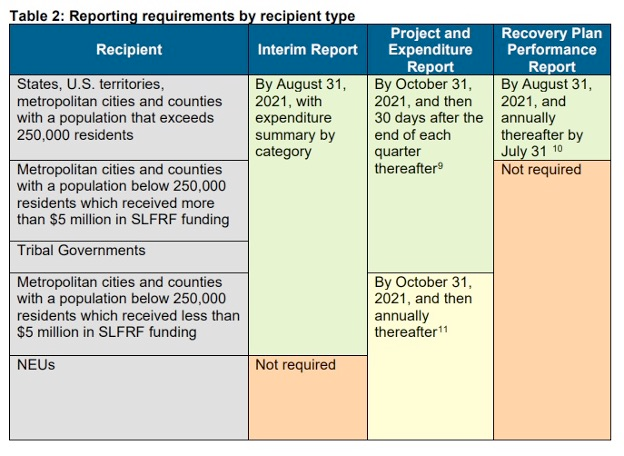
There are now three (3) types of reporting requirements for SLFRF program funds: the Interim Report (Section A, page 13), the Project and Expenditure Report (Section B, page 15), and the Recovery Plan Performance Report (Section C, page 23). We have taken a deeper dive into these reporting types and have created a guide to the Reporting Requirements for the Treasury’s SLFRF.

The following table describes new reporting requirements by recipient type:

Expenditures may be reported on a cash or accrual basis, as long as the methodology is disclosed and consistently applied. Reporting practices must be consistent with the definition of expenditures found in 2 CFR 200.1. Your organization should also implement controls to ensure timely adherence to all reporting requirements for your subrecipients as well.

Subrecipient Monitoring  

SLFRF recipients that are pass-through entities as defined under 2 CFR 200.1 are required to manage and monitor their subrecipients to ensure compliance with requirements of the SLFRF award pursuant to 2 CFR 200.332 regarding requirements for pass-through entities. First, your organization must clearly identify to the subrecipient:  

  1. That the award is a subaward of SLFRF funds;
  2. Any and all compliance requirements for use of SLFRF funds;
  3. Any and all reporting requirements for expenditures of SLFRF funds.

Your organization will need to perform a risk assessment to evaluate each subrecipient’s risk of noncompliance. These risk assessments may include factors such as prior experience in managing Federal funds, previous audits, personnel, and policies or procedures for award performance monitoring.

The Office of Management and Budget’s (OMB) Uniform Grant Guidance (UGG) demands standard ways of tracking and monitoring subrecipients, including: 

  • Providing clear performance goals, indicators, and milestones for your subrecipients based on OMB-approved standard information collection methods;
  • Reviewing their financial and performance reports;
  • Following up as necessary to ensure that recipients take appropriate action.

We have created a guide for local governments to help reduce the administrative burden associated with subrecipient monitoring progress to help you and your subrecipients maintain compliance.

Single Audit Requirements

Recipients and subrecipients that expend more than $750,000 in Federal awards during their fiscal year will still be subject to an audit under the Single Audit Act and 2 CFR Part 200, Subpart F.

For-profit entities that receive SLFRF subawards are not subject to Single Audit requirements. However, they are subject to other audits as deemed necessary by authorized governmental entities, including Treasury, the GAO, the PRAC and the Treasury’s OIG.

Recipients and subrecipients can refer to the Office of Management and Budget (OMB) Compliance Supplements for audits of federal funds for more information, and the Federal Audit Clearinghouse to see examples and single audit submissions.

*Seal image from U.S. Department of the Treasury

Four Ways to Get Involved with NGMA

Have you ever thought to yourself “I want to make the most of my NGMA membership and get more involved in the NGMA community, but I just don’t know how”? I want to share four simple ways that you can get engaged with NGMA that goes beyond merely attending monthly webinars and the annual grants training. These are concrete suggestions of how to volunteer and engage socially and professionally with your fellow peers.

Getting involved with NGMA benefits both you and the greater grants community. By taking advantage of any of these opportunities to get involved, you may be able to expand your network, learn valuable insights from your peers, build your professional profile, and give back to an organization that has uniquely benefited your career.

1.    Volunteer on an NGMA Member Committee

There are a surprising number of opportunities to volunteer your time with NGMA. Whether you are new to grants management or if you a well-seasoned veteran in the field, there is a volunteer opportunity for you that will fit your strengths and talents. For example, there are many NGMA’s Member Committees that you can volunteer on.

To volunteer, visit the simply visit the NGMA Member Committees webpage and reach out to the NGMA Staff liaison of the committee that you are interested in.

In addition to the national member committees, there may be opportunities to volunteer at your local chapter level. And for those experienced and well-established NGMA community members there is always the opportunity to serve on the board as well.

Volunteering requires a small-time commitment but has a huge impact on how NGMA serves its members and our community. Serving is also an opportunity to shape your own experience as an NGMA member.

Most importantly volunteering with NGMA is an opportunity to connect with your fellow peers who are working behind the scenes to continually add value to our grants management community.

2.    Participate in NGMA’s Members Only Discussion Board—NGMA Community Forum

One of the best ways to keep up to date with the constantly changing grants management field is to participate in the NGMA Community Forum. You can connect with fellow chapter or sector members and subscribe to receive periodic updates right to your inbox, so that you always know the latest issues and updates in the grants management world.

I know that I have used this resource to leverage the experience of my peers on several occasions, and I always try to reciprocate by answering others’ questions when I can. So, if you have not had the opportunity, try posting a question, or answering one, try starting a CGMS study group, or try joining your local chapter’s discussion board. There is no limit to how we can use our network to help and support each other.

3.    Engage at AGT

As an NGMA member, chances are that you have likely attended the yearly grants pilgrimage known as the Annual Grants Training (AGT). But maybe you have not seen the tireless effort of staff and volunteers behind the scenes putting it all together. Volunteering to help with the AGT is a great way to meet the NGMA staff as well and the renowned speakers that share their excellent learning sessions at the meeting each year. Volunteering is easy too. Whether it is joining the Education Committee to help review and approve of presentations, volunteering to be a moderator for several sessions, or volunteering to check attendees in at our next in-person meeting, there are plenty of ways to participate. Keep an eye out for communications from NGMA staff for your opportunity to participate next year.

4.    Get Your CGMS Certification

The process of studying for and sitting for your CGMS credential is a unique but important way of getting involved in the grants community. The immediate reasons to get you CGMS are obvious, but the journey to getting it and the esteemed community that you join after you get your credential are equally as important. If you are eligible to take the exam, I highly encourage you to start or join a CGMS study group, take the GMBoK training, and join the community of CGMS holders.

I can attest from my own experience, that being active with NGMA has opened a lot of doors for me and has been essential to my continued growth as a grants management professional. Please consider getting involved if you can and remember it is never too early or too late to get involved in our NGMA community.


About the Author:

Brent Ramsey, CGMS is a Compliance Manger at the non-profit SCORE and is Vice-Chair of the NGMA’s Education Committee. Brent has been a member of NGMA since 2018.

Amplifund: Setting Standards to Achieve Compliance

Setting standard processes is critical to maintaining compliance. After the passage of the Digital Accountability and Transparency Act, (DATA Act) in 2014, the Office of Management and Budget’s (OMB) Uniform Grant Guidance (UGG), and the Grant Reporting Efficiency and Agreements Transparency (GREAT) Act of 2019, all organizations receiving Federal funds are required to report their spending data using government-wide data standards.
When it comes to compliance, UGG requires standard reporting to ensure good controls are in place during an audit; however, what those standard reporting processes must entail is not very prescriptive, so your organization will have to answer questions when deciding what these processes can, or should, look like. Such as:

  •     How can you create standard processes that drive best practices?
  •     How can you help maintain your organization’s existing effective workflows, or create new workflows?
  •     How can you maintain compliance?

The processes that your organization may choose to implement, or already follow, can include additional steps that are not specifically required by any key legislation, and may include the addition of departmental specifics, people, and additional data collection practices. This blog post aims to provide some best practices for both grant seekers and grant makers that you can implement in your organization to drive best practices, maintain compliance, and maximize your outcomes.

Data Management & Systemization

According to paragraph 4(c)(2) of the DATA Act, organizations must, to the extent that it is reasonable and practical, “incorporate widely accepted common data elements,” and/or “incorporate a widely accepted, nonproprietary, searchable, platform-independent computer-readable format.” A common interpretation of this language is your processes should revolve around the standardization and systemization of data. Collecting key data in a systematized manner will also allow for multiple form completions and can help expand the capacity of your resources. A grant management software can assist you with centralization and standardization.

Personnel Identification and Sign-Off Procedures

To drive best practices as a grant seeker or grant maker, you must identify the key personnel that will need to sign-off on the pursuit of, awarding of, or monitoring of funds. While the personnel involved from award to award may change, the implementation of a specific level or role of sign-off will help maintain compliance and minimize audit struggles. A process that requires internal sign-off further ensures agreement across key programs and departments. In addition, standard operating procedures regarding authorization will further increase transparency, which will provide financial visibility into the status and health of various programs or awards.

Application

Grant Seeker

Creating a standard process for tracking the grants you apply for holds both your team members and your organization accountable for the success of your grant portfolio. Maintaining these application records in a centralized location will help ensure that your team members will not apply to competing, or the same, funding opportunities as their colleagues, as well as be able to track your success rate.

Grant Maker

Standardizing your grant application will ensure a fair and equal application process for all applicants. By creating a standard application, you can effectively evaluate which programs are best suited for your organization’s mission using the same criteria, which will help you distribute funds in an inclusive and equitable way. By creating a concise application that is accessible online, or through an applicant portal in your grant management software, you can further ensure that the application process will be both accessible and standardized for your applicants.

Application scoring is a critical internal function of making awards; and standardizing a review and scoring process ensures that each application is reviewed in the same way by the correct reviewers at the appropriate time. Creating a review process and workflow for application scoring creates internal visibility into the status of the overall applicant portfolio for your organization. It can also help you begin to determine what kinds of monitoring may be required for your pool of recipients.

Reporting Structures

Grant Seeker

Establishing standard reporting structures once a grant is awarded will provide financial oversight and can help your organization adhere to a timeline with milestones that can be used for benchmarking. While you may already have a specific form in use for different funding streams, you can create a process that keeps the structure of reporting similar from award to award to provide consistency in reporting within your organization.

Grant Maker

In order to monitor the performance of your recipients, you’ll want to create a process that requires standard reporting structures at regular intervals. Your process for reporting should drive standard reporting structures that include benchmarking milestones to a timeline, so you can gain insight into your recipient’s project performance.  While there might be specific data elements in use for different funding streams, the structure of the reporting process itself can be similar.

Achieving Compliance

Due to the importance of creating standard processes, the need for centralization, and to drive the creation of accurate, systematized reports, your organization may choose to implement a grants management system (GMS) to help maintain compliance, implement effective and efficient processes, and drive accountability.

Whether you are a grant seeker, a grant maker, or both, the creation of processes to collect standard data is critical for maintaining compliance.

There is a great deal of leeway provided to organizations when it comes to creating those standard processes, however. While this means that it is possible to integrate and maintain each organization’s own processes and workflows that are currently working for them, it also creates the potential for processes that may not be as effective. By keeping the goal of standardization in mind, your organization can begin to set standard processes to achieve compliance.

A configurable grant management system can help your organization create and maintain standard processes and workflows. Check out our blog on how you can further help standardize your grant portfolio management.

Grants Made Simple

 We’re excited to share the launch of our new microsite in partnership with Government Technology!

Click HERE to Learn More

________________________________________________________________

Grants Made Simple

Simplify your entire grants process with innovative software and services designed by practitioners and Certified Grants Management Specialists.

_________________________________________________________________________
Hero Highlights

Hear the real stories of grant professionals making an impact in the communities using eCivis solutions.
Click below to learn why we call them “hero highlights.”

Learn how CA HCD managed over $811.7
million in COVID-19 funding.
Learn how Detroit increased its
grant revenue by over $202 million.

Learn how Atlanta increased its number
of annual qualified proposals by 44%

Learn how Harris County was able to
track as many as 750 grants at the same time.