Mastering Financial Transparency: Key Strategies for Audit-Proofing Your Organization

In September 2024, Tasha Fox led a webinar presentation on mastering the art of financial transparency. The objectives of the presentation were to understand the scope and requirements of large-scale audits across various public and nonprofit sectors, develop and implement robust internal control systems, and create a comprehensive audit preparation plan adaptable to diverse organizational needs Below are key takeaways from her presentation.

Missed the webinar? View the recording HERE. (Member login required.)


____________________________________________________________
Financial transparency is crucial for both the public sector and nonprofit organizations. By focusing on three key areas, you can navigate the complex world of financial audits with confidence and use them as opportunities for improvement. Here are three essential strategies to help audit-proof your organization:

1. Understanding Audit Scope and Requirements

A fundamental step in preparing for an audit is understanding its scope and requirements. Different sectors face unique challenges:

  • Public sector organizations often deal with financial audits, compliance audits, and performance audits, each with its own focus and requirements.
  • Nonprofits may face financial statement audits, Single Audits for federal funding recipients, and state-specific audits.

Regardless of your sector, it’s crucial to familiarize yourself with the relevant regulatory frameworks, such as Government Auditing Standards (Yellow Book), Office of Management and Budget (OMB) Uniform Guidance, and Financial Accounting Standards Board (FASB) Accounting Standards.

2. Developing Robust Internal Control Systems

Strong internal controls are the backbone of financial transparency and audit readiness. It’s important to tailor these controls to your organization’s specific needs:

  • Public sector entities should focus on segregation of duties, budgetary controls, and transparent procurement processes.
  • Nonprofits need to pay special attention to donor fund management, volunteer oversight, and controls over fundraising activities.

Implementing effective financial policies and procedures, leveraging technology for enhanced control, and addressing common weaknesses are all critical steps in building a robust internal control system.

3. Creating a Comprehensive Audit Preparation Plan

Being proactive in audit preparation can significantly reduce stress and improve outcomes. An effective preparation plan should include:

  • A timeline with key milestones, working backwards from the audit date.
  • Meticulous organization of financial records, ensuring completeness and accuracy.
  • Advance preparation of key financial documents, including sector-specific documentation.
  • Internal pre-audit reviews to identify and address potential issues early.
  • Team preparation through clear role assignments and training on audit processes.

By focusing on these three areas – understanding requirements, strengthening controls, and thorough preparation – organizations can approach audits with confidence and use them as opportunities for improvement and transparency.

Remember, mastering financial transparency is an ongoing process. Stay informed about changing regulations, continuously refine your internal controls, and view each audit as a chance to enhance your financial management practices.

Tasha Fox, CPA is an instructor for Graduate School USA and the founder of Fox Accounting Services.

Key Takeaways on Maximizing Recovery on Your Grants by Leveraging Indirect Cost

In January 2024, Nicolie Lettini of Cherry Bekaert led a webinar presentation on leveraging indirect costs to maximize profits. The objectives of the presentation were to define indirect cost; learn how it is determined and how it impacts organizations; and understand how to maximize revenue by leveraging indirect cost. Below are key takeaways from her presentation.

Missed the webinar? View the recording HERE. (Member login required.)
____________________________________________________________Key takeaways regarding indirect cost:
1. Understand True Cost. Direct cost and indirect cost should not be considered two separate items.  Cost is cost, no matter how you slice it. A common perception is that recognizing and claiming indirect cost related to a grant will take dollars away from the program. This implies that indirect cost is optional. Indirect cost is a component of True Cost, and therefore exists and is not optional. Too many organizations end up subsidizing the indirect cost component, which creates sustainability risk. If a program becomes too expensive to subsidize, then the program is likely to become short-lived. So remember, just because you don’t recognize indirect cost does not mean it doesn’t exist, you are subsidizing and taking tax payer dollars away from General Fund services such as Public Safety and Parks and Recreation.
2. A Negotiated Indirect Cost Agreement (NICRA) is almost always a better option than the 10% de minimis. While it takes time and effort to come up with the indirect cost rate calculation, most organizations will find that the indirect cost rate is significantly higher than 10%. Besides knowing you have a higher rate, the additional benefits of having a NICRA far outweigh the up-front work to obtain one:

  • Cost Recovery – As mentioned above, indirect costs are real costs incurred by the organization as a result of the grants it manages. By collecting indirect costs on grants, the organization can recover some of these costs and maintain its financial stability over time.
  • Improved Financial Management – By collecting indirect costs, the organization can gain better visibility into the true cost of managing grants and allocate resources more effectively. This can help the organization make informed decisions about the grants it manages and ensure that it is using its resources efficiently. Sometimes, it can even inform a decision to not go for a grant because the subsidy would be too great and exceed the award (yes, this happens – there is a transportation grant out there with an indirect cost rate of 110%)!
  • Compliance – Many funding agencies require grant recipients to collect indirect costs on grants to ensure that the funds are being used appropriately and that the true cost of the program is understood. In some cases, grant applicants may look more favorable to the grantor when an understanding of indirect cost is demonstrated by having a NICRA.
  • Match Requirement – You have the ability to use your NICRA as your match requirement, which frees up cash AND allows you to access new grants that you would have otherwise passed up due to inability to set aside the cash as match requirement.
3. One of the biggest challenges for recipients, grantors, and cognizant agencies alike is that the Uniform Guidance isn’t perfectly clear in some areas, leaving room for subjective interpretation. One of these areas has to do with admin cost versus indirect cost. These are two separate things.

Admin cost is typically related to the cost to service a handful of grants. For example, admin cost is the salary and benefits of the grant administrator/program manager spread over the grants they support. Indirect cost, on the other hand, is not readily identified with a specific project or organizational activity and is related to agency wide indirect cost that support not only grants but all services in an organization regardless of funding source – think of this as the cost of running payroll and IT support services related to the support of the overall grant and all direct staff supporting it. Now, some grant Notification of Funding Awards (contracts) clearly spell out that no indirect cost is allowed, however may still provide for an admin cost, and usually with a cap. In that case, you would not be able to claim anything besides admin cost. But it is critical to note that the grant contract must explicitly state that “indirect” is unallowable not just admin, otherwise indirect is allowable.

Nicolie Lettini, MBA, is a director with Cherry Bekaert. She has more than 23 years of experience providing accounting, advisory and cost allocation services, financial analysis and management consulting services to government contractors, government and public sector, nonprofit organizations and professional services clients

Understanding the Single Audit, Common Pitfalls, and How to Avoid Them

In September 2023, Claire Hilleary and Ariel Lybarger of Moss Adams led a webinar presentation on common Singl Audit pitfalls and how to avoid them. Below are key takeaways covered in their presentation.   

Missed the webinar? View the recording HERE. (Member login required)

What Is a Single Audit?

A Single Audit, also known as a Uniform Guidance audit, is a comprehensive examination of an organization’s financial statements and compliance with federal award requirements. Single Audits are conducted to ensure organizations expending federal awards meet the necessary regulations and are accountable for the funds they receive.

A Single Audit includes an audit of both your organization’s financial statements and compliance with federal award requirements for those programs identified as major programs—based on application of the risk-based approach and criteria outlined in Title 2 Code of Federal Regulations (CFR) Section 200.518 and .519—for the audit.

Through the audit process, the auditors determine whether your organization’s financial statements fairly present the financial position of the organization and whether they’re presented in accordance with Generally Accepted Accounting Principles (GAAP) or another comprehensive basis of accounting.
Both the financial statement audit and the compliance audit provide information on the internal controls design appropriateness and operating effectiveness, which enables management to identify systematic weaknesses in a timely manner.

What Governs How It’s Completed?

The standard-setting body that governs Single Audits in the United States is the Office of Management and Budget (OMB). The OMB issues the Compliance Supplement that auditors use to conduct Single Audits. Single Audits are required for non-federal entities (NFEs) that expend more than $750,000 of federal dollars within their fiscal year. An NFE means a state, local government, Indian Tribe, Institution of Higher Education (IHE), or not-for-profit organization that carries out a federal award as a recipient or subrecipient. Recently, OMB proposed revisions to the Uniform Guidance, most notably to raise the Single Audit threshold from $750,000 in federal awards expended within a fiscal year to $1 million, the first increase in the Single Audit threshold since 2013.

Types of Findings

Audit findings can be categorized as a Financial Statement finding or a Compliance finding:

Financial Statement
A financial statement finding relates to accounting controls or the accounting assumptions used to prepare the accounting records. These findings represent departures from GAAP or deficiencies in the internal controls designed to ensure the financial statements fairly present your organization’s financial condition.

Compliance
A compliance finding is related to noncompliance with federal laws, statutes, regulations, and program terms and conditions, or deficiencies in the internal control over compliance designed to ensure the organization complies with such provisions. This type of finding is specific to an individual compliance issue for a major program.

Financial statement and compliance concerns must be evaluated and categorized into one of three categories: a control deficiency, significant deficiency, or material weakness.

Control Deficiency
The design or operation of a control over financial reporting or compliance doesn’t allow management or employees to prevent, or detect and correct, misstatements or noncompliance on a timely basis. A control deficiency is less severe than a significant deficiency.

  • Design deficiency. A control necessary to meet the control objective is missing, or an existing control isn’t properly designed so that, even if the control operates as designed, the control objective wouldn’t be met.
  • Operation deficiency. A properly designed control doesn’t operate as designed or the person performing the control doesn’t possess the necessary authority or competence to perform the control effectively.

Significant Deficiency
A deficiency, or combination of deficiencies, that is less severe than a material weakness, yet important enough to merit attention by management.

Material Weakness
A deficiency, or a combination of deficiencies, exists in internal control for either financial reporting or compliance, such that there’s a reasonable possibility that a material misstatement of the entity’s financial statements or material noncompliance won’t be prevented, or detected and corrected, on a timely basis.

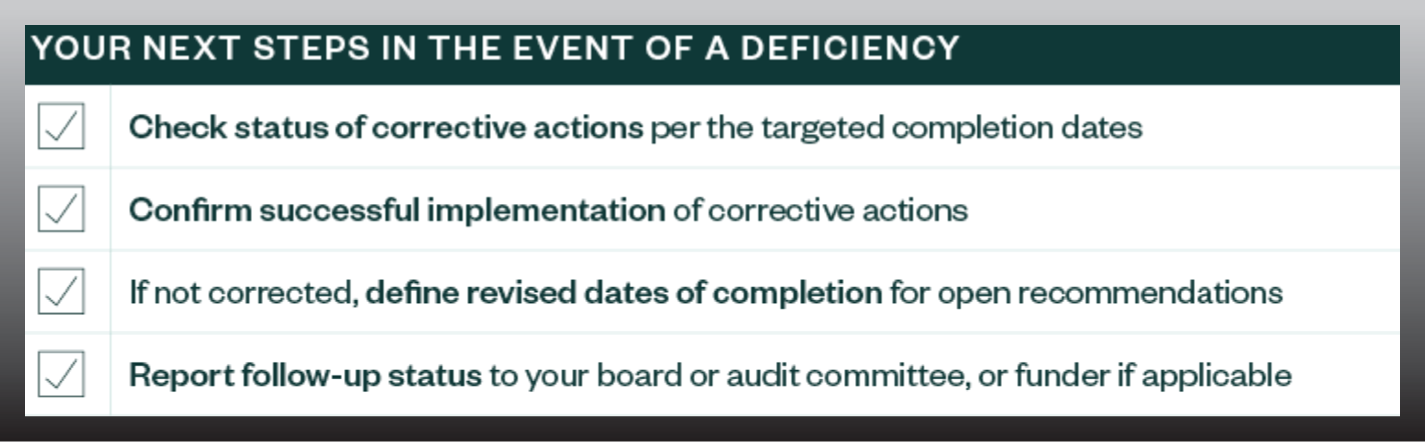
Material weaknesses and significant deficiencies in internal control over financial reporting or over compliance must be reported as part of the financial statements or Single Audit report. Internal control or noncompliance concerns not categorized as a material weakness or significant deficiency can be communicated in a separate management letter to the auditee.

Next Steps Checklist

What Will Your Single Audit Look Like?

Each Single Audit is different, so it’s important to discuss with the auditor what to expect, what should occur, your responsibilities, and the specific duties of the auditor. Cover this in your engagement letter.
Factors that influence what occurs during the audit include the complexity of your organization and the availability and completeness of the documentation supporting the internal control system, financial statements, and program activities and expenditures.

Generally, auditors will perform audit steps to:

  • Determine if your organization’s financial statements are fairly presented
  • Determine if the Schedule of Expenditure of Federal Awards (SEFA) is complete, accurate, and fairly presented in relation to your financial statements
  • Gain an understanding of and potentially test key internal controls
  • Determine if your organization complied with select federal statutes, regulations, and terms and conditions of your federal awards
  • Follow up on prior audit findings
  • Obtain evidence to form and support their opinions on the financial statements and program compliance
  • Develop and report internal control and compliance findings for the current year in the Single Audit report

Auditors won’t provide any opinion on your internal controls. If they identify something they see as an issue, they’ll report it as a finding, but won’t offer opinions as they would on the material accuracy of your financial statements or compliance.

If a finding related to internal controls is identified, and corrective actions are taken, an internal audit specific to those controls and processes may be an effective way to prevent the finding in subsequent years.

Common Pitfalls in Grant Compliance

The most common pitfalls in grant compliance are found in the following areas:

  • Reporting
  • Matching, level of effort, and earmarking
  • Sub-recipient monitoring
  • Eligibility
  • Allowable costs
  • Indirect costs
  • Procurement

Reporting

  • Inaccurate reports. Time and effort reporting, including inconsistent application of requirements across all funding sources, and time charged across all sources exceeds 100%.
  • Unsupported report data. Point-in-time system reports not retained.
  • Late reports. Delinquent report submissions or unsubmitted project close-out reports.

Matching, Level of Effort, and Earmarking

  • Inaccurate records. In-kind volunteer hours not reviewed.
  • Inaccurate calculations. Currency conversion or insufficient match funds due to Excel formula error or conversion not performed.
  • Supplement, not supplant. Funding is meant to augment, not replace.

Sub-Recipient Monitoring

  • Assistance Listing Number (ALN), formerly the Catalog of Federal Domestic Assistance (CFDA), not communicated to sub-recipients
  • Unique Entity ID (UEI), formerly the Data Universal Number System (DUNS) number, verification not completed
  • Risk assessments not completed regularly
  • Monitoring not completed, or not completed adequately or in a timely manner

Eligibility

  • Inaccurate determination. Program participants didn’t meet the maximum age, income, or geographic thresholds; no process in place for eligibility determination, such as age, income, background checks, and citizenship
  • Record retention. Process doesn’t ensure consistent retention of documentation

Allowable Costs

  • Payroll allocations are based on an estimate rather than actual
  • Time related to program payroll isn’t contemporaneously documented
  • Time related to program payroll isn’t reviewed and properly approved
  • Program expenses aren’t reviewed and approved by grant manager
  • Costs not allowable
  • Costs not properly supported

Indirect Costs

  • Indirect costs include unallowable costs
  • Indirect rate is misapplied
  • Indirect methodology not documented or not applied consistently across programs

Procurement

  • A procurement policy exists, but the organization doesn’t enforce it
  • The organization has appropriate procedures but didn’t update its policy
  • The organization cannot prove that a vendor was checked for suspension and debarment
  • Sole source justification wasn’t properly completed
  • Supporting documentation is not retained to support due diligence performed

How to Prepare for a Single Audit
Prior to the audit, there are actions your organization needs to take. Below are some steps auditees can take to help your Single Audit go smoothly.

  • Gather and summarize all federal grant information
  • Prepare financial statements and notes
  • Prepare a detailed draft of the SEFA
  • Ensure policies are developed and up to date, in place, and comply with the federal awards
  • Provide the auditor with access to information
  • Review prior Single Audit findings
  • Prepare the Schedule of Prior Audit Findings
  • Review and update internal controls
  • Seek help, when or if needed – asking questions early and often may prevent audit findings in the future

Five Grants Management Systems to Develop to Ensure Success

When a grants manager hears the term “grants management system,” they may picture a complicated, costly, technology-driven, data management system that requires an outside professional consultant to develop. This perception frequently leads to the employing entity to dismiss consideration, citing budget constraints. In truth, I have found that an effective grants management system can be a simple set of tasks or activities that help a grant manager understand administrative responsibilities, programmatic commitments, subaward/subrecipient management, expense monitoring, and overall performance tracking and reporting. Of course, there are other tasks and activities to consider, however, developing a firm understanding of these five systems has worked for me and my colleagues. Here, I will focus on simple systems that can be deployed without the cost of developing a technological solution.

Administrative Responsibilities

Understanding that administrative responsibilities start well before a grant is awarded, or even considered, is crucial.  The entity must have the capacity to:

  • perform general administrative tasks associated with reviewing opportunities;
  • assist programmatic staff in developing effective project narratives, timelines, and budgets;
  • meet the application requirements according to grant guidance documents;
  • interact with grantors;
  • communicate with stakeholders, including other business units within the entity; and
  • ensure that an effective structure is setup in the entity’s accounting systems.

This is not an exhaustive list but should give a general understanding that there is a significant investment of time and effort associated with the administrative responsibilities required for a given grant. These activities can be managed using something as simple as a checklist that includes as many foreseeable tasks as possible.

As new tasks are identified, updating the checklist is essential to ensuring the next grant is sufficiently evaluated for capacity, as compared to performing the task and hoping to remember it the next time. To enhance the effectiveness of a checklist, it is helpful to identify the staff or functional area responsible for each item or section of the checklist. Doing so provides the broadest opportunity to assess an entity’s overall capacity and to weigh the cost of capacity against the value of a grant.

Example: If the most basic administrative capacity requirements total 240 staff hours, at an average of $30 per hour, the minimum capacity cost is $7,200. This does not include the cost for programmatic staff to perform implementation commitments. For a $20,000 grant, the administrative costs are 36% of the grant, excluding any applicable fringe benefits or indirect costs. Many grants allow a maximum of 10% administrative costs. In such a case, it is probably not in the entity’s best interest to pursue a $20,000 grant.

Programmatic Commitments

For this article, “programmatic or program” refer to the business unit or staff implementing the grant. With a few exceptions, there are most likely specific outputs and outcomes for which the program has made a commitment.   Commitments, sometimes referred to as deliverables, are specified in a project narrative and/or work plan. There is an expectation that commitments or milestones will be completed within estimated time periods or not later than the end of the project period specified in the grant award. Developing a system for tracking commitment status and timelines can, again, be as simple as creating a checklist by converting the commitments from a narrative format to a line-item format, complete with due dates and a space for status notes.

Example: The commitment in a narrative format may be presented as: Through this grant, the energy costs will be lowered by an average of 20% for 45 disadvantaged homeowners in the first quarter of the grant’s project period through the purchase and installation of energy-efficient windows.
Converting the narrative into a measurable line-item format might be presented as: This grant will benefit 45 disadvantaged homeowners (output) to reduce household energy costs by an average of 20% through the purchase and installation of energy-efficient windows (outcome) in the first quarter of the project period (timeline).

For this example, the status at the end of the first quarter could be something to the effect of: 48 households benefited; average energy cost reduced by 27%, or 34 households benefited; average energy cost reduced by 17%; commitment delayed due to window supplier backorder.  

Through this type of checklist, both updates make visible the progress for the commitment and are available in a single location for inclusion in any required performance reports to the grantor. The checklist will also play a role in the Performance Tracking and Reporting section discussed later.

Subaward/Subrecipient Management

The systems discussed in this section are the result of identifying and addressing prior significant deficiencies. My organization had a lot of “hit and miss” attempts to develop a single solution over the past several years. A major lesson I learned is that you don’t know what you don’t know until you find out that you don’t know, and then you have no choice but to fix it. This has been the mantra that propelled my organization to prioritize the development of our current system, which addresses pre-award, subaward agreements, and post-award implementation of subawards.

By mirroring the typical grant cycle, we are able to capture activities that had often been skipped or performed in a less-than-effective manner. As with prior sections, the system can start with a simple checklist that includes the various activities and requirements. However, because of the complexity surrounding subawards and subrecipients, we engaged in a process-mapping exercise that starts from the moment the need for a subaward is identified through all of the steps leading up to the subrecipient receiving reimbursement for services rendered. The results of the mapping led to multiple systems for ensuring appropriate and compliant selection of subrecipients; standardized agreement templates that include all federal and/or other grantor requirements; standardized subrecipient budgets and reimbursement requests; standardized expense review and approval processes; standardized monitoring and risk assessment.

As mentioned earlier, each of these systems can be combined and used as a checklist, or they can be maintained as separate components to be used, depending on the phase of the subrecipient management cycle. The key takeaway here is that a system, even an imperfect system, will help a grant manager be successful. The more activities and tasks that are captured in and through the system, in addition to the consistent standardized manner in which an organization adheres to the system, is paramount.

Expense Monitoring

While it may seem intuitive, revenue and expenses associated with a grant should be tracked separately from the entity’s other sources of revenue and expenses in a financial management or accounting system. However, that may not always be the case. A successful grants manager will ensure that each grant is uniquely identifiable and trackable.

My organization has a robust financial system that prevents comingling grant funds with other funding sources, including other grant sources. However, that alone does not always provide the information needed to ensure appropriate monitoring. Financial accounting often captures the what, the who, and the amount associated with an expense; however, it rarely captures the why. This is where an additional system becomes necessary.

Two of the more effective and efficient systems used in day-to-day expense monitoring are what we refer to as a tracking tool and a standardized expense review process. Each grant has its own standard tracking tool that serves the purpose of capturing the data that will help assemble both financial and performance reports. The tracking tool is set up to be in alignment and make visible the original budget as approved in the grant award, as well as tracking the actual expenses incurred in each cost category. An observation prior to implementing the tracking tool was that when a grant was awarded and the budget established, there was little attention paid to actual expense allocations occurring during a given performance reporting period. This led to significant rework, expense transfers, and requests to the grantor to reallocate the budget, with no guarantee that the request would be approved. This opened our organization to substantial financial risk and the likelihood of noncompliance. The tracking tool functions as an early warning system if spending drifts unexpectedly.

The system used for standardized expense review applies to all grant expenses as well as subrecipient reimbursements. The system is similar in nature to a checklist, but is arranged according to the role each responsible party has in the process. This system was developed in response to an internal audit observation showing inconsistent expense review and approval processes among programs. A deeper audit revealed that the inconsistency frequently led to missing steps and authorized approvals, leading to rework and disqualification of expenses lacking sufficient supporting documentation. The system includes steps that the program must perform, including confirming that the expense is in alignment with the grant parameters and adheres to the basic cost principles of being necessary, reasonable, and allocable. The program must also ensure that appropriate supporting documentation is included, such as detailed invoices and performance reports, when applicable. The grant manager confirms the information and ensures appropriate program approvals are in place and adds it to the tracking tool before forwarding the request to Accounts Payable, where additional standard steps have been assigned for the person processing the transaction. This system has corrected the deficiencies through standardization, which includes clearly communicated roles and responsibilities.

Performance Tracking and Reporting

Performance reporting requirements are a primary expectation included in nearly all grant awards. The majority of grantors want to confirm that the program is implementing the grant according to the award and its related terms and conditions on schedule and within budget. Financial systems and the tracking system described in the Expense Monitoring section are sources for responding to the financial performance of implementing the grant. Having a system to track commitment performance is equally essential to the success of a grants manager. An effective grants manager will confirm that the reporting expectations are included in the checklist described in the Programmatic Commitments section. As mentioned earlier, the checklist makes visible the commitments and progress. The visibility ensures an additional level of accountability to the program.

The checklist’s visibility can help a grants manager compile additional performance metrics to be provided to the entity’s internal leadership, even if it is not a grant reporting requirement. An example of metrics of interest to my organization’s leadership include the percentage of commitments completed relative to the total commitments, the percentage of commitments completed within the established timelines, and the actual outputs and outcomes versus the estimated outputs and outcomes.

Example: Five completed commitments out of 25 total commitments is 20%. Of those five, three were completed within the timeline, or 60% on time. One of the commitments completed on time estimated that 45 households would benefit from the commitment (output) to provide disadvantaged homeowners with energy-efficient windows to reduce household energy costs by 20% or more (outcome). However, the actual number of homeowners receiving assistance was 49 and the average cost savings was 27% per household. This means that the commitment served 8.8% more homeowners and the savings were 35% higher than expected. These four performance metrics serve to show that the program is progressing through the completion of commitments but is missing the time commitments 40% of the time. The entity leadership or grants manager may want to know why there are delays and what can be done to help the program achieve its goals. If this information is presented in the grantor reports, it is highly likely that the grantor will be pleased to see that their assistance provided an even greater benefit than expected, even if it took longer than estimated. Most of all, this information can be easily captured through the checklist at any given point in time.

In addition to the benefits of the checklist, establishing a reporting calendar for the grant that triggers reminders to responsible parties helps to manage adherence to the grant requirements. A component of the reporting system I have found works for me is adding key internal dates on my calendar as a meeting to which I invite the responsible program staff. This serves as an effective “check-in” with the program and confirms report due dates.

In conclusion, having strong, consistent grants management systems in place, no matter how simple or complex, will help a grants manager be more successful in performing day-to-day activities. Continuous improvement to those systems, clearly defined roles, frequent communication, visibility, and leadership support increase efficiency and reduce the likelihood for audit findings or redundancy in effort. Standard work processes are essential. When multiple parties are performing grants management functions in silos with different processes and procedures, it will (not might) lead to problems that are often costly and time-consuming to remedy.

Robyne Clark, CGMS is a grants manager with the Arizona Department of Environmental Quality. Her favorite part of grants management is helping the recipient program staff who are applying for and/or implementing a grant navigate through the processes. She has been a Certified Grants Management Specialist (CGMS) since 2019.

Making an Overwhelming Workload Manageable

How does it feel to be the only person in the state in my role and engaging in my work? It’s a good thing I thrive in a fast-paced environment with a dozen things happening simultaneously! The Every Student Succeeds Act (ESSA) authorized each state to create a nonpublic ombudsman to provide support to both public and nonpublic school stakeholders. My primary responsibility as ombudsman is to ensure the provision of equitable services occurs according to the law. Equitable services are provided by the public school district to eligible children, teachers and families enrolled in a nonpublic school who wish to participate in Title I, IIA, III or IVA federal programs. In my state (Ohio), this equates to nearly $37 million of equitable services delivered to 557 nonpublic schools by 405 public districts. Because of the size and scope of equitable services in Ohio, my time is always in demand. Needless to say, my workload requires implementing solid organizational processes to ensure good job performance. Below are a few steps that work for me:

Advocate for Yourself and Your Work

Knowing what’s best for yourself and your job and advocating for it is critical to your success. When I was given the role of ombudsman, it was on top of my existing role as a consultant in the Office of Federal Programs at the State Department of Education. As a consultant, I had a full-time caseload of public school districts that I supported through the entire grants management process. From reviewing consolidated applications to subrecipient monitoring, I was doing it all. As ombudsman, I added the roles of supporting every district and nonpublic school in the state specifically on the provision of equitable services. This was too much for one person, even me. To demonstrate how heavy my workload was, I tracked all the equitable services inquiries and questions I received from the field and presented it to my superiors. This data supported my request to move to 100% full-time ombudsman. This was huge, as now my sole focus is on equitable services and providing support to the entire state – nonpublic and public. I would not be able to do this had I not had the consultant work removed from my workload.

Plan Ahead and Prioritize

Being able to effectively plan ahead and prioritize tasks is essential to my work.  If I have a deadline I am working against, I always push it back and give myself an earlier deadline.  I do not know when an emergency complaint or situation may come to me. I want to ensure that if one does, I can devote the time necessary to bring it to resolution. I also schedule my work time by blocking off my calendar for tasks. This shows my colleagues that I am “busy” and lets me have uninterrupted worktime to focus on the task at hand. During busy times, I will also let phone calls ring to voicemail so that I can keep the rhythm of the job I am working on. Later, after completing my primary tasks, I return the calls. I am very good at using all available resources.  I rarely “reinvent the wheel”.  I frequently take a resource that I have already created for the field and repurpose it for a specific audience or situation.

Create an Organizational System That Works for You

Organization is key. In order to meet the never-ending demands that come with grants management, you must be organized! My busiest time of year is during sub-recipient monitoring. Since my primary responsibility includes monitoring the provision of equitable services, I participate in nearly all our in-person, onsite reviews of school districts that provide equitable services to nonpublic schools.  During these reviews, I monitor fiscal records as well as programmatic requirements. I may visit multiple nonpublic schools and public districts in a week. It is essential that I take clear notes on my observations and findings.

I am a paper, sticky notes and highlighter kind of girl. When I return to the office from my meetings, I take notes and updates on my follow-up actions on the same Word document. This helps me keep each district separate as I work with them on their findings and corrective action plans. Many of my colleagues have transitioned to digital organization, but I am very “old school.” This system works best for me. Whether you prefer to organize your work digitally or stick to “old school” methods like me, find what works for you. Organizational systems are important for successful grants management!

Communicate and Be Transparent

Even though I am the only nonpublic ombudsman in our state, I am part of a great team. I make sure to keep communication open with and provide transparency to my team. For example, I provide training to our consultants who review grant applications and also model how to review applications for nonpublic issues by peer-reviewing the applications. I make my peer review notes available to both the grantee and the consultants who reviewed the application. This strengthens the knowledge of the team, building capacity, which ultimately makes my job easier. If I ever need assistance, I have colleagues that are quick to step in to assist. I am not afraid to ask for help when I need it.

Advocating for yourself and your work, planning ahead, creating an organizational process that works for you and having strong communication skills are all essential in being successful in your role. Above all else, it is essential that you take time to recharge. Time to yourself is necessary to ensure your efficiency level is 100% at work. I am very good about closing my laptop at the end of the workday and leaving behind the work demands.

Working in grants management is not something I ever saw in my future.  I “fell” into it and I love it. It is challenging, demanding and keeps me on my toes. I enjoy working in a fast-paced environment and thrive on challenges.  My personality is well suited to the position.  I think it would be very difficult to do this position if “organized chaos” was not something I could tolerate.

Chantelle Carter is a Nonpublic Ombudsman with the Ohio Department of Education. She has been providing support to public and nonpublic school in this and previous roles for more than nine years. Prior to her grants management roles, she was a decorated classroom teacher and a director of educational operations at a non-profit learning center. In her downtime, Chantelle enjoys hanging out with her dogs and being outdoors.

Key Takeaways on Procurement Committees Under Federal Awards: Ensuring Compliance and Maximizing Efficiency

In July 2023, Dan Durst and Sly Atayee of BDO led a webinar presentation on conducting procurement committees under federal awards. The objectives of this webinar were to review best practices for setting up procurement committees (e.g., structure, personnel, documentation), help grantees prioritize compliance while maximizing efficiency, and to provide a clear understanding of purchasing rules under 2 CFR 200 Uniform Guidance and when committees should be used


Takeaway #1 – Know Your Regulations!

When establishing a procurement committee under federal awards, it is critical that any committee is structured and operated in accordance with the applicable federal regulations and procurement standards. As such, committee members should clearly understand the procurement standards set forth in 2 CFR 200 Uniform Administrative Requirements, Cost Principles, and Audit Requirements for Federal Awards (Uniform Guidance) which establishes the rules and requirements over an entity’s administration of federal awards. The Uniform Guidance regulations specific to “Procurement Standards” are covered in sections §§200.317 through 200.327a. Special attention should be paid to the following sections with regards to how the procurement process should be set up to ensure fair and open competition while ensuring a reasonable price is paid:

  • §200.318 – General procurement standards
  • §200.319 – Competition
  • §200.320 – Methods of procurement to be followed
  • §200.324 – Contract cost and price

Takeaway #2 – Best Practices for Conducting Procurements Under Federal Awards

There are a few best practices for conducting procurements committees under federal awards that organizations can incorporate while modifying each to fit their needs based on risk and available resources:

  • Set procurement thresholds based on actual data – If your organization mostly makes smaller purchases (or purchases overseas where currency conversions result in low USD amounts), consider using a micropurchase threshold less than the allowed ceiling of $10,000. Similarly, if your organization never makes purchases over $250,000, it may not make sense to make that the threshold for when you use procurement committees. A simple review of your general ledger can give an idea of where to set thresholds.
  • Ensure at least two parties are involved in all steps of procurement processes to enhance visibility and reduce fraud risk – this is especially true of front-end processes (e.g., soliciting quotations) where all committee members are usually not involved.
  • Utilize technology when feasible to streamline and automate procurement processes – most ERP systems today have a bolt-on procurement function, or you can find low-hassle software that can automate workflows and document every step of the procurement process. When performing evaluations as part of a committee, this process can be done electronically using an established scorecard.
  • Incorporate stakeholder input to enhance procurement processes – when necessary, you can recruit outside stakeholders (e.g., your contracting officer) to be a part of your committees.
  • Seek opportunities for continuous improvement and performing periodic evaluations of committee to determine resulting effectiveness – your first committee won’t be perfect, but you can make improvements over time!

Takeaway #3 – Risk Mitigation is Important in Procurement Committees

There are a number of pros and cons to consider when deciding whether to establish a procurement committee. While procurement committees offer a lot of benefit to an organization, they also present some risks, including potential:

  • Conflicts of interest within the committee.
  • Policy noncompliance – as procurement committees are more complex, there’s a higher chance that committee members will do something outside of what is required in your policies, which can lead to audit findings.
  • Lack of transparency in committee activities and decisions due to poor documentation.
  • Lack of technical expertise if committee members are not knowledgeable or experienced in procurement processes for federal awards.
  • Introduction of inefficiencies or delays in decision-making or processes if the committee is not well-managed – otherwise known as “death by committee.”

Once all risks have been mitigated, procurement committees offer great benefits to organizations by helping to:

  • Systemize purchasing processes for larger, complex procurements.
  • Ensure the organization’s procurement activities meet formalized requirements for compliance – this applies to purchases over the Simplified Acquisition Threshold.
  • Provide a means for escalating decision making around purchasing – higher dollar purchases mean higher risk and more formal procedures should be required to ensure these decisions are properly vetted.
  • Preserve organizational integrity and reduce scrutiny from unsuccessful bidders by having a clearly documented process for collecting, evaluating and selecting bids.
  • Enhance transparency, accountability, and fair competition.
  • Offer leveraged expertise and diverse perspectives that can be available within a committee.
  • Verify that no conflicts of interest exist by enforcing strict acknowledge requirements for all committee members for each committee session.

Dan Durst is Managing Director and Sly Atayee is Senior Manager at BDO, a consulting firm that assists state and local governments, nonprofits, and institutes of higher education in several key areas, including but not limited to full lifecycle grants management, forensics and investigations, financial risk management, excellence in financial operations, and strategy.

Now is the Time to Embrace Technology in Grantmaking

By WizeHive, Grant Management Software

Leveraging technology in grantmaking is an excellent way to streamline your workflow and to ensure that your grants are set up to have the greatest effect. With its ability to increase efficiency and modernize the process of managing government grants, technology can help maximize your impact. Read on for a primer on why embracing the evolving role of technology is one of the best choices you can make for your grants management processes, your subrecipients, and your community.

It’s time to leave spreadsheets behind.

Utilizing spreadsheets for the management of funding opportunities and grants carries significant limitations. Spreadsheet-based management results in a greater strain on resources, poor monitoring of grant performance and, ultimately, less impact. Following are three sizeable drawbacks to relying on spreadsheets:

1. Challenges to data integrity. When done manually, data gathering, input, and analytics are likely to suffer from a degree of human error. This can result in compromised integrity of grant data, and as a result, less trust in your agency.

2. Time intensive management. Manual tasks, such as application processing, budget tracking and reporting require a considerable amount of time and place a substantial administrative burden on grant managers.

3. Limited process transparency. When the grants process is run manually, transparency—which helps prevent fraud as well as misuse of funds—is often sacrificed. Because management is labor intensive, the added burden of gathering and publishing data for purposes of transparency and accountability tends to be overlooked or varies depending on which staff member takes on the task.

How technology can help maximize your impact.

Technology allows grantmakers to benefit from a unified management system, which encompasses the full lifecycle of the grant and results in numerous benefits, such as: streamlined processes, increased transparency, standardized data reporting, improved resource allocation, trend spotting, data-driven decision making, and comprehensive risk mitigation.

1. Streamlined Processes.
Grantmakers can set up automated workflows that route applications, approvals, and notifications to the appropriate personnel. Automated validation and review systems can check application completeness, verify eligibility criteria, and flag any errors or inconsistencies. Workflow automation reduces administrative tasks and ensures that processes follow predefined paths. It also allows for better collaboration and coordination between reviewers and decision makers, who can access applications digitally, and collaborate remotely. This enhances accuracy and speeds up the processes of review and decision-making.

2. Increased Transparency.
With grant management technology, transparency and accountability are ensured via application tracking features and post-award monitoring. Automated programs simplify audits and support alignment with policy objectives. Governments can also make grant information accessible to the public through online databases, fostering transparency and trust and enabling stakeholders to track the allocation and use of funds.

3. Standardized Data Reporting.
Technology enables the real-time capture and updating of data, eliminating lags that come from manual data collection. Data standardization and mapping (both of which are accomplished via technology for grant management) ensure that data is cohesive, organized, and can be transformed or migrated as needed.

4. Improved Resource Allocation.
Grant management technology ensures consistency and reduces the workload of manually capturing and integrating data points, freeing up time and lightening workload, which results in improved human resource allocation. Such efficiency frees up time and resources, enabling staff to focus on higher-value activities, such as strategic planning and program evaluation.

5. Data-driven Decisions.
Consistent and streamlined reporting processes facilitate data-driven decisions and evaluations. With the aid of data analytics, governments can monitor grant outcomes, identify trends and patterns, and assess the impact of funding. Analyzing data from multiple grants can provide insights into trends, program effectiveness, and performance, which can further help in making informed decisions about future funding allocations.

6. Risk Mitigation.
Technology assists in managing risks associated with grants. Digital systems can incorporate checks and controls to ensure compliance with regulations, policies, and reporting requirements. The enhanced communication enabled by online platforms and project management tools helps clarify expectations, address queries and issues promptly, and foster stronger relationships between government agencies and grant recipients. Technology can also aid in conducting audits and monitoring grant expenditures, identifying any potential issues or irregularities.

Maximizing your impact by harnessing the evolving role of technology.

Grantmakers and their processes must be agile to keep up with the changing needs of the communities they serve. Their grant management software must continue to evolve to keep up with grantmakers’ needs as well. By leveraging the latest technology, grantmakers can benefit from increased efficiency, transparency, and accountability, along with improved decision-making and optimized resource allocation. In addition to the inherent benefits of each advancement, when applied together, these improvements have a transformational effect on the grant management process, resulting in the most valuable outcome of all: maximized impact for grantmakers, subrecipients, and the communities they serve.

Developing Grants Management Capabilities to Sustainably Deliver Long-Term Impact

In May 2023, NGMA hosted the webinar “How Can We Develop Grants Management Capabilities to Sustainably Deliver Long-Term Impact?” presented by Greg Kowalski and Ranjana Ramchandran of Ernst & Young LLP and Shamiah Kerney, Mayor’s Office of Recovery Programs (Baltimore, MD). Below is a summary of the presentation.


Over the last few years, state and local governments have had the unique opportunity to implement multiple innovative programs to serve their residents. Focusing on program outcomes rather than just fiscal and reporting requirements can enhance optimization of funds, effective program design and collective achievement of agency objectives.

Entities face several key challenges in measuring and delivering value across their portfolio of programs. First, resource constraints often divert focus from outcome measurement, as daily administration of funds is prioritized over longer-term monitoring of outcomes. Next, outcomes must be measured within discrete periods of performance, which may be as short as one to three years and influenced by leadership’s strategic planning cycles. Finally, program governance often lacks integrated outcome measurement, as projects are often executed in silos.

Entities can address these challenges through the development of a grants management transformation office, incorporating the following three elements:

  1. Integrated program governance enables planning across in-flight programs and tracking of key milestones, dependencies, and outcome realization. This includes a risk management framework to triage and escalate issues while actively assessing initiative and program risk and its impact to desired outcomes. This may also include an initial assessment of program capacity to verify that entities have the infrastructure in place to implement innovative programs that may be outside the scope of their typical operations. By approaching planning and governance with the desired outcomes in mind, entities can consider factors beyond funding availability and timelines when making key decisions impacting their communities.
  2. Ask thoughtful questions to develop meaningful key performance indicators (KPIs) to measure outcomes across programs. To develop metrics, entities should begin by identifying high-level categories to understand the program impact on various stakeholders (e.g., scholar experience). This may be followed by a research question (e.g., are we initiating enough touchpoints with scholars?) and associated metrics (e.g., increase in average number of touchpoints with scholars in a program year), sourced from new or existing program reporting requirements. Often, demographic information may be collected and reported after decisions have been made, limiting entities’ ability to make changes impacting program success. To obtain a holistic view of program value, it is important that metrics include indicators of both short-and-long term progress.  In some instances, this might require working with supporting stakeholders to measure long-term value beyond the program timeline.
  3. Measure outcomes leveraging existing data and improve ongoing execution. The implementation of an “assess-improve-monitor” framework can enable entities to assess how new program requirements impact risk, develop processes for managing an evolving risk profile, and conduct ongoing monitoring activities to evaluate whether those processes are designed and effectively operating. This presents an opportunity to cross-reference existing programmatic and financial data to identify trends, identify funds at risk for non-compliance, re-allocate funds to more impactful activities, and improve program execution through technical assistance and education. Increased capacity building stemming from these activities can ultimately result in the capture and administration of additional funds driving community impact.

By integrating review of program performance into planning cycles, entities can better understand the impact of their spending, and make in-flight changes aimed at maximizing value.

Ranjana Ramchandran is Managing Director, Forensic & Integrity Services; Greg Kowalski is Senior Manager, Business & Consulting; and Brooke E. Wanlass is Senior Manager, Business & Consulting at Ernst & Young, LLP.

Post-Award Best Practices

In June 2023, NGMA hosted the webinar “Preparing for Post-Award – What You Need to Know.” Kristen Krey and D’Laun Oubre, the grants management team at Kim Joyce & Associates, provided best practices on post-award grants management. Below is a summary of their presentation.


The grants management team at Kim Joyce & Associates has a daily mantra: “Track, track and then do more tracking.” Post-award is all about compliance, and if it isn’t on paper, it didn’t happen. Compliance is defined by the Oxford dictionary as “The action or fact of complying with a wish or command.” In the case of post-award management, we don’t comply with wishes (although we try to work magic sometimes), but with the commands of the processes, policies, rules, guideline, and regulations established by the funder. Fortunately, we have lots of resources and best practices with which to model and work our magic!

Below are best practices to ensure your organization is prepared for the challenge of compliance and post-award management.

Understand your role – Is your organization a direct recipient, a pass-through entity, a sub-awardee? Will your organization account for a sub awardee?

Know the requirements of your funding and funder – Review and know the laws, regulations, OMB circulars, 2 CFR 200, grant terms and conditions and the grant application.

Establish internal controls – This step is especially critical in financial reporting, and important to your program reporting. Have policies, process procedure tools and segregation of duties in place prior to accepting the award.

Manage through change – Identify organizational change created by the grant. Work through approved grant changes. Be aware of changes to grant requirements and other changes outside your control.

Create integration – Recognize that it takes a team to manage a grant award! Create your team of subject matter experts that are responsible for reporting, i.e., financial, programming, procurement and community outreach.

Ensure effective systems are in place – This is a cornerstone step to successful financial reporting and receiving reimbursements. You also need to develop policies that prevent unallowable costs and require that these policies are followed.

Be fluent in cost allowability – Costs must be reasonable, allocable and necessary to the project. Costs must also comply with the funding statutes and funder requirements. Make sure your team is fluent with these statutes and requirements as well.

In conclusion, to be successful in your grants management approach, make sure your intentions are aligned with your systems. Spend the money and track your expenditures. Do what you say you are going to do and track your activities. Communicate with your team and your funder. Finally, work your magic accordingly!

Kristen Krey is the Director of Government and Community Engagement at Kim Joyce & Associates, a full-service grants consulting firm.

Once Upon a Grant: Storytelling for Sharing Impact

Do you ever wish that people were as excited about your work as you are? Disappointed that they don’t “get” what you’ve been able to accomplish? Afraid that what you’ve done and learned will go unappreciated – or worse — unacted-upon? Remember these four simple words…

“Tell me a story.”

Stories are powerful tools. They give your work meaning beyond merely sharing the results in a report. Grant managers seeking to highlight their accomplishments should look for ways to tell performance stories – bringing grant impact to life through narratives that guide an audience through all the elements of your project and leave them with a clear sense of what should happen next.

The best performance stories contain these elements:

  • Context – what were the project’s purpose, goals, objectives, and needs?
  • Outcomes – what happened (both intended and unintended)?
  • Achievements – how did participants benefit and how did you make progress?
  • Lessons learned – was it the right approach, and if not, how did you respond?
  • Research quality – what assurances do you have that the story checks out?

Of course, a story is meaningless without an audience. Before you tell your story, think about who needs to hear it and why. Keep in mind that different audiences might have different needs; a federal agency looking to achieve broad programmatic goals may not be as close to the specific work as those with whom you collaborate – and certainly not as invested as direct beneficiaries of the effort. Using logic models or other techniques that link desired outcomes to more specific project efforts and interventions can help you ensure that your performance story is reaching your audience(s).

Because context is important, no two performance stories are alike – and should not be told the same:

  • Sometimes, you will tell your story in straightforward, plain language so an audience unfamiliar with their work can “find their way in.”
  • Other times, you might engage in a dialog with your audience, allowing them to “choose their own adventure” as they learn more about the work.
  • You might even use testimonials so that the work – and the people affected – can speak for themselves.

Keep in mind also that performance stories also do not stand alone: with each one you tell, you are not only describing your current project but also setting the scene for future work – building an “arc” that gives context to everything you have done and will continue to do.

We’d love to hear your story – and help you tell it to the people who need to hear it most.

Nicole Togno and Tim Podkul are a part of the Evidence and Insights division of Fors Marsh, a full-service consulting firm that specializes in building evidence about grant programs. www.forsmarsh.com