Management Concepts: What Does Flexibility Mean for Grants Management?

The word “flexibilities” appears 12 times in Promoting Public Trust in the Federal Government through Effective Implementation of the American Rescue Plan Act and Stewardship of the Taxpayer Resources (M-21-20). Agencies are instructed to apply these flexibilities when appropriate and innovate with them, but what does that actually mean?

Intended Purpose

The purpose of these flexibilities is part of the recurring theme we’ve seen from the Office of Management and Budget (OMB) since the beginning of the Uniform Guidance development process — stressing performance over compliance and reducing recipient burden. This is not to say that compliance is not important, but rather that we should avoid compliance for its own sake, like checking off list items instead of making real progress.

OMB acknowledges that agencies know their programs and grantees best, and the Guidance is not one-size-fits-all. The Uniform Guidance grants agencies the power to make exceptions and ask for waivers. The most recent changes to the Uniform Guidance continues to build on this theme ― expanding use of the de minimis rate for indirect costs, among other changes.

COVID-19 Related Flexibilities

Last spring, OMB issued Administrative Relief for Recipients and Applicants of Federal Financial Assistance Directly Impacted by the Novel Coronavirus (COVID-19) (M-20-11), which established certain short-term flexibilities specifically for awards that were directly supporting research and services needed for the emergency response to the pandemic. Ten days later, OMB issued Administrative Relief for Recipients and Applicants of Federal Financial Assistance Directly Impacted by the Novel Coronavirus (COVID-19) due to Loss of Operations (M-20-17), expanding on this guidance and applying these flexibilities to all agencies and assistance programs affected by COVID-19, and a year later, we know that was most agencies.

A year later, M-21-20 seeks to update these flexibilities in the context of the American Rescue Plan and recent executive orders. Appendix 3 – Disaster Relief Flexibilities to Reduce Burden for Financial Assistance specifically outlines the options agencies have to reduce recipient burden and enact flexible grants management.

The intention of these flexibilities is not to loosen requirements merely to make things easier ― it is to reduce requirements or allow alternative arrangements to facilitate or expedite the effective use of funds.
OMB is saying not to let the process get in the way of the results. However, it is still important to understand the process and requirements. Here are a few example potential scenarios.

Application Scenarios

  • Pre-approval Waiver – An agency is granting emergency funding to a grantee to set up COVID-19 testing sites. The grantee has already ordered testing supplies and paid the first month’s rent for a testing facility before the period of performance begins. Typically, these pre-award costs would need specific approval to be considered allowable. Under M-21-20, OMB is allowing agencies to waive pre-approval requirements as long as all costs charged to the award are consistent with the terms of the award and federal cost guidelines.
  • Registration Extension – A non-profit wants to apply for funding from an agency but is not registered or certified in the System for Award Management (SAM) as required by 2 CFR 200. M-21-20 allows agencies to relax the timing of the requirement for active SAM registration and allows a one-time extension to entities whose registration expires between 4/1/2021 and 9/30/2021. Therefore, the agency can grant an award to this grantee as long as a pre-award risk assessment is conducted, and the non-profit can complete the SAM certification concurrently.

In addition, M-21-17 grants flexibility on compliance-related deadlines: extension of reporting deadlines such as the federal financial report (FFR), single audit submission, grant closeout, and management of physical inventories. In most cases (excluding single audit), this needs to be a conversation between the agency and the grantee. For all flexibilities, grantees and agencies should document the reasons for the adaptations (i.e., why the single audit extension was used, why an FFR was delayed, why they requested the closeout period to be extended). Strong communication between grantor and grantee is still expected, as is effective stewardship of the funds.

Now more than ever, OMB wants grant funds to be used quickly and effectively. These flexibilities are designed to allow that―to facilitate effective, results-oriented delivery that benefits agencies, grantees, and the American public.


Sarah K. Hluchan is the Grants Product Management Director for Management Concepts. She has spent her career facilitating effective grants management through process improvement, policy development, and education. She holds a BA in political science from Drew University and a Master of Public Policy from the McCourt School at Georgetown University.

How Kansas Effectively Distributed Over $1 Billion in CARES Act Funding

It goes without saying that 2020 has presented some serious challenges for state and local governments.

Never before have governments had to navigate the magnitude of funding–over $150 billion from the Coronavirus Relief Fund under the CARES Act– and distribute it in such a short amount of time.

Unlike the typical grants process, where you prepare a plan, indicate how you’re going to spend the money, do the work, and then get reimbursed, the urgent nature of the pandemic has forced governments to account for their spending in the aftermath.

So how can governments efficiently and transparently navigate this unchartered territory?

Learn more in our first-ever Hero Highlight (where we share how inspiring grants leaders and their associated governments innovatively managed their grant funding and delivered incredible impact to their communities).

Through a deliberate and careful process of strategic planning, Cheryl Harrison-Lee, Interim Executive Director of the Recovery Office (and our heroine of this hero highlight) helped the state of Kansas manage over $1.043 billion in CARES Act funding and established a framework that served as a financial reporting template for benchmarks and metrics. Cheryl shares the state of Kansas’ lessons learned and what other governments can do to ensure similar successes of their own.

Establish Community Priorities First

One of the most significant challenges for governments has been determining how and where to spend funding as effectively and efficiently as possible. During her tenure, Cheryl and her team focused on developing strategic priorities revolving around the biggest impacts of the pandemic: health, education, connectivity,  and the economy. Once they analyzed the major impacts of COVID-19, they were able to quickly delineate priorities at the state level and outline priorities at the county level as well.

Having served at the local, city, county, and state level, it was easy for Cheryl to apply her strategic planning and priority-based budgeting expertise that spoke to the needs of a wide variety of communities. Ultimately, the funding addressed healthcare (i.e. more testing) and helping small businesses reopen safely (i.e. PPE and business continuity). The most important distribution method for Cheryl and her team was using the reliable “tier method.”

“We implemented a tier system where the state distributes to the county and the county distributes to the cities,” Cheryl said. “This allows local governments to directly receive their money and work within their communities. Kansas has 103 counties so by staying at the county level, it allowed us to be efficient and expedient.”

This helped save significantly on the timeline of deciding who would get the funding, which would have been exacerbated if Cheryl and her team had to work with every single city and county within Kansas.

Avoid the “Government-Alone” Approach

Given the ever-narrowing timeframe that governments have to incur their CARES Act funding (Dec. 30th being the deadline), the state of Kansas would not have been able to navigate on its own. For Cheryl, bringing in the perspective and voices of stakeholders in the form of a steering committee (which served as a planning advisory committee) and executive committee (which functioned as the recommending body to the Governor and State Finance Council) was crucial.

She and her team sought input from a wide range of public and private-sector stakeholders, including representatives from health, businesses, education, construction, and banking/finance communities. It was especially important that these stakeholders represented many voices. For example, one of the executive board members was the president of the Kansas Hospital Association. Cheryl expressed that without these voices, she and her team would not have been able to access all the ideas that they could as well as ensure everyone had their needs met. For the state of Kansas, it was all hands on deck.

“In a moment of crisis, there’s a heavy lift and that load requires everyone lifting all at once, instead of a government alone approach,” Cheryl said.

Ultimately, by including a diverse group of stakeholders from the beginning, Cheryl and the stakeholder committees were able to help the state get $700 million approved and $400 million of that amount was disbursed within 60 days.

What Governments Need to Do Now Before December 30th

According to Cheryl, it’s especially important that state governments do their utmost now to ensure subrecipient success. She advises that governments take the following steps before the big December deadline:

  • Return funding to the state if you cannot meet the deadline. If counties or local governments have to return any funding, they can return it to states, which can then be added to an unemployment compensation pool or redistribute to entities that have unmet needs. It’s important to send any funding back to states to expand programs they already have in place in alignment with the CARES Act, especially if you are unable to determine where you’re spending funds by the Dec. 30th deadline.
  • Engage your audit firm in advance. Make sure you have your auditors walk through every stage of the grants process with you. This way, as you establish priorities, distribute, and manage funding you know you’re going to meet all your audit requirements in advance. Also, it’s important to document EVERYTHING as you go and have electronic files available.
  • Establish a paper trail with your legal unit. With so many gray areas in the CARES Act, the state of Kansas set up a code interpretation unit with legal counsel so they could track and answer questions as they came up. This also ensured a paper trail was created which showed what decisions were made and how the government arrived at such decisions. Counties could also gain more clarity by being able to ask states about those gray areas and get legal interpretations of eligible expenditures, better ensuring they could justify their spending down the road.

More information > 

eCivis: 6 Takeaways From the Latest Guidance on the American Rescue Plan Act

On March 19, the White House Office of Management and Budget (OMB) issued a memorandum for the heads of executive departments and federal agencies (M-21-20).

This memo was released to give guidance to federal agencies to foster accountability and public trust by delivering effective and equitable relief, while implementing sound financial management of the resources funding that relief. This will include working with the Pandemic Response Accountability Committee (PRAC) and agency Inspector Generals to strengthen payment integrity so governments can minimize the risk of waste, fraud, and abuse. Additionally, the guidance aims to help governments improve the overall award and administration of financial assistance programs with an increased focus on human-centered program and service design to achieve more equitable results.

Reducing Administrative Burden on Funding Recipients

In an attempt to help governments receive and distribute funding faster amidst the urgency of the pandemic, Appendix 3 of the OMB memo gives guidance to agencies on how they can reduce administrative burden on recipients’ performance and deliverables. The guidance applies not only to COVID-19 related awards, but also non-COVID-19 related awards.

The guidance is directed to the executive department and federal agencies by OMB in accordance with Uniform Guidance 2 CFR 200. Agencies may allow these exceptions as they deem appropriate and to the extent permitted by law.

Here are six of the 12 areas of guidance given to federal awarding agencies that will affect recipient awards:

1. Flexibility with SAM/recertification

Federal awarding agencies may relax the timing of the requirement for active SAM registration at time of application to expeditiously issue funding. At the time of award, the requirements of 2 CFR § 200.206, the federal awarding agency’s review of risk posed by applicants continue to apply. Current registrants in SAM with active registrations expiring between April 1, 2021 and September 30, 2021 will automatically be afforded a one-time extension of 180 days.

2. Waiver for Notice of Funding Opportunity (NOFO) Publication

Awarding agencies may publish emergency and competitive NOFOs for grants and cooperative agreements for less than 30 days without separately justifying shortening the timeframe for each NOFO. Recipients, however, will need to monitor funding opportunities and be prepared to compile an application in a shortened amount of time.

3. No-cost extensions on expiring awards

To the extent permitted by law, awarding agencies may extend awards that were active as of March 31, 2021 and scheduled to expire prior or up to December 31, 2021–automatically at no cost for a period of up to 12 months. This will allow time for recipient assessments, the resumption of many individual projects, and a report on program progress and financial status to agency staff. Project-specific financial and performance reports will be due 90 days following the end date of the extension. Awarding agencies will examine the need to extend other project reporting as the need arises. Recipients should contact their awarding agencies for information.

4. Abbreviated non-competitive continuation requests

For non-competitive continuation requests scheduled between April 1, 2021 and December 31, 2021, awarding agencies may accept a brief statement from recipients to verify that they are in a position to: (i) resume or restore their project activities and (ii) accept a planned continuation award. Agencies must post any specific instructions on their website as well as examine the need to extend this approach on subsequent continuation award start dates as recipients have an opportunity to assess the situation.

5. Extension of Single Audit submission

Awarding agencies, in their capacity as cognizant or oversight agencies for audit, should allow recipients and subrecipients that have not yet filed their single audits with the Federal Audit Clearinghouse as of the date of the issuance of this memorandum that have fiscal year-ends through June 30, 2021, to delay the completion and submission of the Single Audit reporting package, as required under Subpart F of 2 CFR § 200.501 to six months beyond the normal due date. Recipients and subrecipients taking advantage of this extension would still qualify as a “low-risk auditee” under the criteria of 2 CFR § 200.520.

Recipients with fiscal year-ends through June 30, 2021, will receive a six-month extension beyond the normal due date to submit to the Federal Audit Clearinghouse. Findings within the six-months after normal due date will not cause the entity to lose their ‘low-risk auditee’ designation.

6. Flexibility with application deadlines

Awarding agencies may provide flexibility with regard to the submission of competing applications in response to specific announcements, as well as unsolicited applications, presuming these exceptions do not negatively impact underserved communities. As appropriate, agencies should list specific guidance on their websites and provide a point of contact for an agency program official.

More information > 

3 Guides and Playbooks

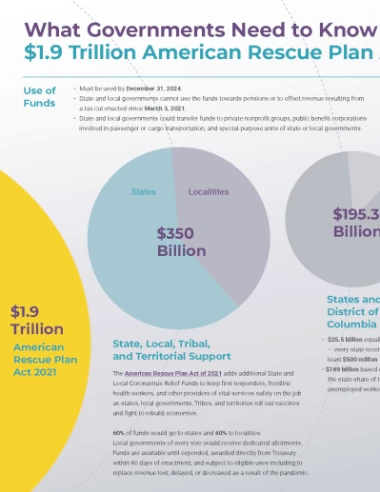
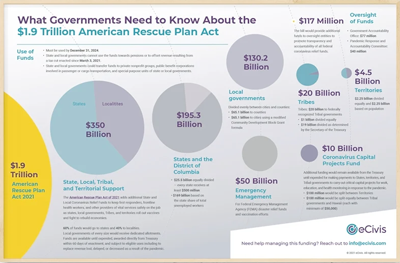
What Governments Need to Know About
the $1.9 Trillion American Rescue Plan Act
Here’s your quick breakdown of how funding will be distributed among state, local, and Tribal governments and Territories

More information > 


_________________________________________________________________________
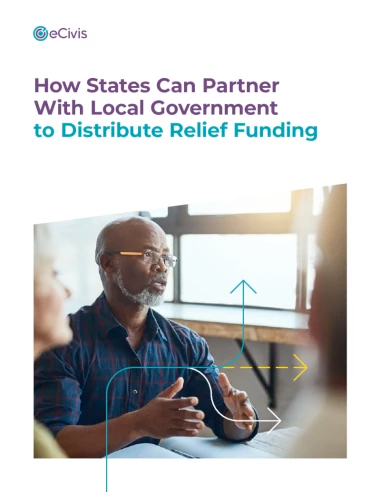
How States Can Partner With Local
Government to Distribute Relief Funding
State and local governments are receiving the largest amount of grant funding yet that will be channeled to communities, small businesses, and individual citizens. In fact, for the very first time, as much as $60.1 billion will be distributed to cities using a modified Community Development Block Grant (CDBG) program formula. However, to ensure this funding actually has the desired impact in communities, multiple stakeholders must work together, especially when it comes to the timely distribution and management of those funds.

More information > 

_________________________________________________________________________
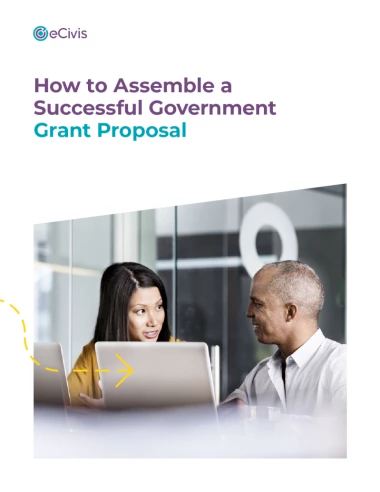
How to Assemble a Successful
Government Grant Proposal
At eCivis, one of the most frequently asked questions in our community of government professionals is “Is there a template out there for putting together a strong government grant proposal?”

While no single template can address the complex and myriad types of funding opportunities, this playbook can help you get started.

More information > 


Amplifund: The Key Players in Grant Management Centralization

Everyone in your organization agrees that you need to begin centralizing your grant management processes. Now the question is, who is responsible for driving and overseeing this shift?

Assembling a Central Grants Office with key roles is one of the first steps leadership needs to take to centralize funding management. The main goals of a Central Grants Office are to provide organizational leadership and oversight over grant policy, evaluation, and training as well as to provide expertise on grant management systems and to streamline processes. That is why you need to rely on those who can make and drive central decisions.

While it may vary by organization, some key personnel from your organization who should be leading your centralization include:

1. Grants Coordinator

The role of grants coordinator is crucial in the Central Grants Office because this individual will essentially be running the office by leading the push for standards, transparency, and compliance around grants. This role will own all grants-related tasks and activities, both in and out of the Office, and will ensure everyone involved is effectively collaborating and communicating.

2. Grants Accountant

To achieve full centralization, there needs to be communication and transparency between the Finance Office and the Central Grants Office. Consider including the grant accountant in the Central Grants Office to facilitate this interaction. This person will also work on financial reports.

3. An expert on ERP and Data

To truly centralize grant management processes, all vital data points need to be connected. That is why an expert on Enterprise Resource Planning (ERP) and data should sit in the Central Grants Office so they can provide key leadership on existing financial tracking and integrations.

Further, the ERP expert will carry out decision-making across and between elements of the organization that rely on the ERP for implementing and tracking information related to Federal grant regulations.

4. Representatives from the key grant making agencies

Organizations need people in the Central Grants Office who can speak to current funding patterns, values, and risk – representatives from key grant making agencies.

This ownership is vital if an organization wants to achieve buy-in for their centralization plan.

5.  Representative from political or executive leadership

Despite how critical it is, an organization can only achieve centralization, as is the case with most big organizational pushes, if there is buy-in and expertise from leadership. Therefore, a representative from political or executive leadership who can advocate for and expedite initiatives is needed in the Central Grants Office.

After team members have agreed to play a role in the Central Grants Office, it’s time to begin centralization practices. To start off on the right foot, the Grants Coordinator should consider it priority number one to develop and disseminate a set of grant management standards to your organization.

Want to learn the two other pillars for centralizing your grant management processes? Check out AmpliFund’s ultimate guide to Grant Management Centralization.

Amplifund: Ad Hoc vs. Formal: The Grant Management Centralization Debate

The recent introductions and updates of new Federal grant regulations are focusing on themes such as transparency, performance, and compliance. To succeed in all these efforts, experts in the grants space are suggesting organizations focus on the more overarching concept of centralization.

This has led to organizations evaluating if and how they should invest in centralizing their grant processes to increase transparency, monitor performance, and maintain compliance.

Specifically, the debate of ad hoc processes versus formal centralization has emerged.

What Are Ad Hoc Grant Management Processes?

Ad hoc processes, or the management of grants on a case-by-case basis, may have been the primary grant management method in the past, but now, only a select few organizations can continue this practice without risking non-compliance.

Ad hoc processes could suffice for your organization if you:

a. Have very few awards to manage

b. Have a limited amount of funding complexity

c. Have one or fewer Federal awards in your grant portfolio

How Can an Organization Formalize Grant Management Centralization?

For most organizations, taking the time to institute formal centralization processes will be necessary to improve outcomes and comply with regulations.

In general, there are three main pillars that set the stage for formal centralization processes. Organizations who require formal processes should focus on:

  1. Building out a Central Grants Office
  2. Designing and disseminating an organization-wide set of grant standards
  3. Ensuring all proper systems for tracking and monitoring awards are in place

Formalizing centralization also extends further than just implementing internal processes and adopting tools. If organizations want to fully formalize centralization, they must also:

  • Be mindful of Federal legislation throughout the grant lifecycle
  • Keep up to date on policy statements
  • Have access to and the ability to post in public portals

Performance measurement is one of the practices your organization will need to centralize if you take the formal approach. To learn more about effective performance management, read AmpliFund’s latest blog on the topic.

Management Concepts: Grant Stewardship and Implementation within the American Rescue Plan

The American Rescue Plan of 2021 (ARP) was signed into law on March 11, 2021. The $1.9 trillion stimulus is perhaps best known for the $1,400 stimulus checks which are already being distributed. In addition to providing immediate relief to workers, the ARP has ambitious policy goals, including safely re-opening schools, supporting the national vaccination program, reducing child poverty, and containing COVID-19.

What’s not making headlines is the grant funding packaged within this bill — grant funding that will make a difference in the lives of millions of Americans. The list below is just a sampling of grant funds to be obligated under ARP.

  • The Department of Education receives $128 billion to fund grants to local educational agencies, plus $39 billion in grants to higher education institutions.
  • The Department of Health and Human Services receives nearly $15 billion for the Child Care & Development Block Grant Program to help support childcare facilities; more than $3 billion to fund grants for mental health care and the prevention and treatment of substance abuse.
  • The Small Business Administration receives $25 billion for a new grant program for restaurants and other food and drinking establishments, with an additional $1.25 billion allocated for the Shuttered Venue Operators Grant Program.
  • The Department of Housing and Urban Development receives $25 billion for emergency rental assistance, including emergency housing vouchers for people experiencing homelessness, survivors of domestic violence, and victims of human trafficking.
  • The United States Department of Agriculture receives more than $1.5 billion to fund Emergency Rural Development Grants for Rural Health Care and the Supplemental Nutrition Assistance Program (SNAP).
  • The National Endowment for the Arts and the National Endowment for the Humanities each receives $135 million for grants to state art and humanities councils and regional organizations.

The legislation compels agencies to move quickly to obligate funds — often within thirty days. This may be a challenge for some agencies, as these additional funds greatly increase the amount of money and number of recipients they will be responsible for.

The administration is clearly aware of the impact the ARP will have to grant-making agencies. On March 19, 2021, OMB issued M-21-20 Promoting Public Trust in the Federal Government Through Effective Implementation of the American Rescue Plan Act and Stewardship of Taxpayer Resources.

This memorandum outlines steps the administration plans to take to support the implementation of the ARP, including working with the Pandemic Response Accountability Committee (PRAC) (previously established under the CARES Act) and agency inspector generals with the goals of minimizing the risk of waste, fraud, and abuse and improving overall award administration “with an increased focus on human-centered program and service design to achieve more equitable results.”

The memo also outlines the responsibilities agencies have — including applying Title 2 of the Code of Federal Regulations (CFR) Grants and Agreements — to the maximum extent authorized by law to all recipients — including for-profits, with limited exceptions. It details measures to take to achieve more equity-oriented results for federal financial assistance and ensure robust and transparent reporting of ARP funds. These points of emphasis align with longstanding grants initiatives, including the DATA Act and the Foundations for Evidence-Based Policymaking Act of 2018, and also align with recent executive orders and memorandums, including Advancing Racial Equity and Support for Underserved Communities Through the Federal Government,  Restoring Trust in Government Through Scientific Integrity and Evidence-Based Policy Making. and  M-20-21 Implementation Guidance for Supplemental Funding Provided in Response to the Coronavirus Disease 2019 (COVID-19).

The memorandum also includes three appendices that provide further guidance on management and oversight of ARP programs and awards:

  • Management of Payment Integrity Risks – outlines additional risk factors to be considered as agencies conduct improper payment risk assessments for programs receiving ARP funding and recommends existing resources for agencies to leverage, and recommends that agencies work with their OIGs to identify other areas of potential risk and support needs.
  • Achieving More Equity-Oriented Results for Financial Assistance – which stresses that agencies are required to administer programs “in a manner that promotes fair and equitable administration of financial assistance and takes a risk-based, data-driven approach that balances compliance requirements with demonstrating successful results.” This appendix is provided to remind agencies of requirements of importance for administering ARP funds and notes that “agencies should apply the requirements of 2 CFR part 200 to all types of financial assistance awards funded through the ARP.”
  • Disaster Relief Flexibilities to Reduce Burden for Financial Assistance – which provides agencies with authority to grant certain exceptions to recipients affected by the pandemic, including flexibility with SAM registration, allowance of pre-award costs, no-cost extensions on expiring awards, waivers for prior approvals, and extensions on financial reporting, single audit submission, and closeout as needed. Agencies are required to maintain records of all exceptions provided.

The ARP represents a huge step forward in facilitating recovery from the pandemic. Effective distribution and oversight of the funding are critical. Agencies should review M-21-20 and plan to work with OMB to effectively steward their funds while providing transparency into what the funds are being used for and working to limit waste, fraud, and abuse.

Thompson Grants: GAO Seeks Action on 66 COVID-Related Recommendations

GAO Seeks Action on 66 COVID-Related Recommendations

The Government Accountability Office (GAO) recently issued 28 new recommendations ― several of which are aimed at financial assistance programs impacted by the COVID-19 pandemic ― and called for action on 38 still-to-be-implemented recommendations previously mentioned in other COVID-related GAO reports that federal agencies can take as an effective response to the public health and fiscal emergency.

Noting that the pandemic continues to result in “catastrophic loss of life and substantial damage to the global economy, stability and security,” GAO cited actions taken by Congress, including enacting the Coronavirus Aid, Relief, and Economic Security (CARES) Act (Pub. L. 116-136), along with other relief packages, “to protect the health and well-being of Americans.” A provision in the CARES Act required GAO to report bimonthly on its federal efforts related to the pandemic, and it has issued six reports to date containing 44 recommendations. However, only six of these recommendations have been fully implemented.

GAO is now urging agencies to take “swift action” on its other 38 prior recommendations. In addition, a March 31 report added 28 new recommendations. “These recommendations are tailored to specific federal programs and initiatives, and, if implemented, will strengthen the efficiency, effectiveness and accountability of federal efforts,” GAO said. “We will continue to monitor the status of these recommendations as part of our ongoing oversight of the federal government’s COVID-19 response and recovery efforts.”

New Recommendations

Among the recommendations GAO included it its recent report are some specific key concerns. For example, the U.S. Department of Agriculture (USDA) administers several federal nutrition assistance programs to vulnerable populations, but had released minimal data about participation in these programs since the pandemic started, and had not publicly shared sufficient information about data quality. Therefore, according to GAO, stakeholders and the public could not access sufficient information about and were not given appropriate context in which to interpret key program data and understand the effects of the pandemic on the programs.

GAO recommended that USDA: (1) provide sufficient context to help stakeholders and the public understand and interpret data on federal nutrition assistance programs during the pandemic, and (2) disclose potential sources or errors that may affect data quality during the pandemic, such as manual processing.

Although the Federal Emergency Management Agency (FEMA) administers Disaster Relief Fund monies, tribal governments told GAO that FEMA did not have staff to assist them when they requested technical assistance related to disaster activities. GAO recommended that FEMA provide timely and consistent technical assistance to support tribal governments’ efforts to request and receive public assistance as direct recipients, including providing additional personnel, if necessary, to ensure that tribal nations are able to effectively respond to COVID-19.

The Department of Education (ED) provided COVID-19 assistance dollars through the Education Stabilization Fund for states’ and territories’ education needs, but did not maintain complete data on how these funds were used. GAO recommended that ED regularly collect and publicly report information on school districts’ financial commitments (obligations), as well as outlays (expenditures) to more completely reflect the status of their use of federal COVID-19 relief funds. For example, the agency could modify its annual report on state and school district spending data to include obligations data in subsequent reporting cycles.

Concerning the Department of Labor’s (DOL) Pandemic Unemployment Assistance (PUA) program, GAO continued to have concerns about overpayments and fraud. As of March 15, DOL reported that states identified more than $3.6 billion in PUA overpayments from March 2020 through February 2021. GAO recommended that DOL collect data from states on the amount of overpayments flagged in the PUA program to effectively monitor the recovery of overpayments.

Concerning the Economic Injury Disaster Loan (EIDL) program, GAO said the Small Business Administration should: (1) conduct and document a fraud risk assessment for the program; (2) develop a strategy that outlines specific actions to address assessed fraud risks in the program on a continuous basis; and (3) implement a comprehensive oversight plan to identify and respond to risks in the program to help ensure program integrity, achieve program effectiveness and address potential fraud.

Another key suggestion GAO provided under the 28 new recommendations called for the Office of Management and Budget (OMB) to work in consultation with federal agencies and the audit community (e.g., agency offices of ) (e.g., agency offices of inspector general; National Association of State Auditors, Comptrollers, and Treasurers; and American Institute of Certified Public Accountants) to incorporate appropriate measures in OMB’s process for preparing single audit guidance, including the annual OMB Compliance Supplement, to better ensure that such guidance is issued in a timely manner and is responsive to users’ input and needs.

Previous Recommendations

Among some of its previous recommendations involving COVID pandemic funding, GAO recommended that as the Department of Health and Human Services redesigns its performance management approach to improve its ability to assess whether the Community Services Block Grant program is meeting the national program goals to reduce poverty, promote self-sufficiency and revitalize low-income communities, the agency should include information on how its national performance measures and state outcome measures align with national program goals and include a written plan for how it will assess data reliability. This recommendation remains open.

Another open recommendation is GAO’s request that OMB develop and issue guidance directing agencies to include as part of their improper payment estimation methodologies COVID-19 relief funding with associated key risks, such as provisions contained in the CARES Act and other relief legislation that potentially increase the risk of improper payments or changes to existing program eligibility rules, as part of their improper payment estimation methodologies. This should be required especially for existing federal programs that received a substantial infusion of COVID-19 relief funding, GAO added.

For More Information

The GAO report, “COVID-19: Sustained Federal Action is Crucial as Pandemic Enters its Second Year,” (GAO-21-387) is available at https://www.gao.gov/assets/gao-21-387.pdf.

FTLF: Preparing for SBA Questions in the Loan Forgiveness Review Process

As many commercial businesses and nonprofit organizations are submitting their Paycheck Protection Program (“PPP”) loan forgiveness applications, considering the possibility of “second draw” loans, and looking back over 2020, it is a good time to discuss preparation for potential Small Business Administration (“SBA”) scrutiny. With potentially short timelines to respond to reviewer questions or an adverse decision, adequate preparation is essential.

How We Got Here

When the PPP Loan Program was first implemented in the spring of 2020, we had little knowledge of how the coronavirus pandemic would affect the national economy and individual businesses. PPP loans were of great interest to both commercial businesses and nonprofits as a tool to weather the unknown. Borrowers approached their lenders in large numbers to submit applications for funds that were widely reported to quickly be running out.[1]

In the initial loan application rush, borrowers faced the challenge of complex federal rules. First, as eligibility was generally limited to small business concerns and certain nonprofit organizations with fewer than 500 employees,[2] taking into account complex SBA affiliation rules,[3] baseline eligibility was complicated for larger borrowers. In addition, loan calculations were complicated by the fact that maximum loan amounts were set at 2.5 times average monthly payroll costs under a very specific definition of what constituted “payroll costs.”[4]

A third challenge quickly arose out of the sheer popularity of the program. National media attention focused early on certain borrowers that seemed unlikely to need PPP loan support to maintain operations.[5] Under heightened public scrutiny, the SBA issued new guidance “clarifying,” a certification that every borrow was required to make in its loan application, namely that: “current economic uncertainty makes this loan request necessary to support the ongoing operations of the Applicant.”[6] The new SBA guidance, issued on April 23, 2020, explained that, in making the certification, the borrower was “taking into account [its] current business activity and [its] access to other sources of liquidity sufficient to support [its] ongoing operations in a manner that [would] not [be] significantly detrimental to business.”[7]

The SBA’s clarification caused considerable concern to borrowers. In an apparent response to these concerns, by May 13, 2020, the pendulum swung back toward a middle ground in which the SBA announced that borrowers of amounts under $2 million would be “deemed” to have made their economic uncertainty certifications in good faith.[8]

With loan proceeds being disbursed by lenders, attention shifted for many borrowers to proper use of the funds on forgiveness-eligible costs. As originally implemented, (i) only certain costs incurred or paid in a brief 8-week “covered period” would be eligible for forgiveness,[9] and (ii) a substantial portion of the funds had to be expended on “payroll costs.” Borrowers were again given some relief by yet another program change, this time by Congress. On June 5, 2020, the PPP Flexibility Act[10] established an option for borrowers to elect a 24-week covered period, rather than 8-week covered period;[11] making it, as a practical matter, fairly easy for most borrowers to expend all loan funds on eligible payroll costs and other costs unambiguously eligible for forgiveness.

The PPP Loan Program largely left the spotlight through the fall as borrowers expended their loan proceeds on “safe” costs, such as payroll and rent, and began to submit their loan forgiveness applications. In preparing forgiveness applications, the most complicated issue is determining whether overall expenses eligible to support loan forgiveness must be reduced due to certain workforce (full time employee (“FTE”)) or salary/wage reductions. Though on the one-hand helpful, Congress and the SBA have promulgated a complex web of exceptions and safe harbors with respect to these reductions. As of the SBA’s February 5, 2021, Federal Register recap of program rules, the rules, exceptions, and safe harbors in this area comprise three full pages of detailed discussion,[12] ranging from exceptions for employees who were terminated for cause or refused offers of rehire, to safe harbors where an organization’s compliance with Department of Health and Human Services (“HHS”), Centers for Disease Control (“CDC”), or Occupational Safety and Health Administration (“OSHA”) guidelines made a return to pre-coronavirus workforce levels impossible.[13]

Remaining a popular stimulus measure, on December 27, 2020, the Economic Aid to Hard-Hit Small Businesses, Nonprofits, and Venues Act,[14] created the possibility of “second draw” PPP loans for businesses and nonprofits with fewer than 300 employees that already had received a PPP loan, but that could demonstrate reductions in gross receipts of twenty-five percent (25%) for 2020 or any quarter therein, as compared to the same time period in 2019.[15]

Against this backdrop, we are left to question where the SBA will land on some of the more complicated issues that borrowers faced in submitting their loan applications and loan forgiveness applications. Since that is something we can speculate about but not truly know, now is a good time to become familiar with the SBA loan forgiveness review process, including borrower rights to appeal unfavorable decisions.

Loan Forgiveness Review Process

Borrowers request loan forgiveness by submitting a loan forgiveness application in a form prescribed by the SBA[16] with supporting documentation.

For each borrower that borrowed $2 million or more, lenders have been instructed to require borrowers to submit, either before or with the loan forgiveness application, an SBA “Loan Necessity Questionnaire” (SBA Form 3509 for commercial businesses and Form 3510 for nonprofit organizations). This form calls for financial information comparing the borrower’s 2020 financial performance to its 2019 financial performance, to “inform SBA’s review of [the borrower’s] good-faith certification that economic uncertainty made [its] loan request necessary to support [its] ongoing operations.”[17] Though no specific element of these questionnaires will necessitate a particular determination, they appear calculated to hone the SBA’s focus on grantees for which 2020 activities and financial performance might indicate the loan was unnecessary.

Upon submission of loan forgiveness applications, lenders have sixty (60) days to reach preliminary decisions and forward them to the SBA.[18] The SBA will review the loan forgiveness applications and lenders’ decisions and, within ninety (90) days, notify the cognizant lender of whether a loan will be forgiven, i.e., paid off by the SBA, in whole or in part.[19]

The SBA has stated that borrowers will have an opportunity to respond to SBA questions in the course of the review process, with SBA sending requests for additional information either directly to the borrower or via lenders.[20] As explained by the SBA in its February 5, 2021, Federal Register notice:

If SBA determines in the course of its review that the borrow was ineligible for the PPP loan under the statute, the SBA rules or guidance available at the time of the borrower’s PPP loan application (for example, because the borrower lacked an adequate basis for the certifications it made in its PPP loan application), the loan will not be eligible for forgiveness. The lender must notify the borrower of the forgiveness amount. If only a portion of the loan is forgiven, or if the forgiveness request is denied, any remaining balance due on the loan must be repaid by the borrower on or before the maturity date of the loan.[21]

While the SBA’s guidance does not describe all details of its internal review process, it does provide some useful insights from which we can surmise:

  • The SBA will likely review original loan applications as part of the loan forgiveness review process, focusing in particular on loans over $2 million. For most borrowers, this review is likely to be the first time the SBA has looked directly at their loan documentation.
  • Given the flexibility created by the PPP Flexibility Act and subsequent SBA guidance on spending loan proceeds, the compliance areas most ripe for SBA scrutiny will be: (i) initial eligibility of borrowers (including interpretation of affiliation rules for larger borrowers); (ii) economic uncertainty certifications in loan applications, and; (iii) eligibility for workforce and salary reduction exemptions and safe harbors.
  • If the SBA has questions during the loan review process, it is likely to ask the lender to contact the borrower for more information before rendering a final decision. Adverse decisions by the SBA are likely to be initially communicated to borrowers via their lenders.

SBA Appeal Process

A formal appeal process has been established for borrowers to challenge adverse SBA decisions.[22]. This process has been codified in the Code of Federal Regulations at 13 C.F.R. Part 134, Subpart L, employing SBA’s Office of Hearings and Appeals (“OHA”).

An administrative judge or administrative law judge from OHA will preside over each appeal, generally as a matter of paper record review and without any oral hearing.[23] Importantly, OHA’s standard of review will be the very high bar of whether the SBA’s “loan review decision was based on clear error of fact or law” with the borrower bearing the burden of proof.[24]

Though this article is not intended to convey all aspects of an appeal, key aspects with which borrowers should be familiar in advance are:

  • The appealable decision must be a “final written decision” of the SBA.[25] This means that a borrower should promptly obtain any underlying final SBA decision if it is not provided along with any adverse communication by their lender.
  • The borrower has only 30 days to file an appeal petition after receipt of a “final SBA loan review decision, or notification by the lender of the final SBA loan review decision, whichever is earlier.”[26]

  • The appeal petition must, among other things, contain “[a] full and specific statement as to why the SBA loan review decision is alleged to be erroneous, together with all factual information and legal arguments supporting the allegations.” Yet, it must not exceed 20 pages (not including attachments).[27]
  • The petition must be accompanied by signed tax returns relevant to the expenses and loan at issue if those returns were not already included in the relevant PPP loan application and/or PPP loan forgiveness application.[28]

  • Generally, within 20 days of commencement of the appeal, SBA will be required to provide to the borrower/appellant the “administrative record” upon which it made its determination.[29] The appellant will have only 10 days from receipt of a copy of the record to assert that the record contains errors or relevant documents are missing.[30]

  • The administrative judge will also set a date for “close of record,” generally within 45 days of appeal commencement, by which date SBA officials will be required to respond to the borrower’s petition.[31] Importantly, according to the PPP loan appeal regulations, borrowers will generally not be permitted any reply to the SBA’s response.[32]
  • OHA’s initial decision is subject to further review by the Administrator of the SBA upon request by the borrower. The SBA regulations state that to exhaust one’s administrative remedies, generally a prerequisite to judicial review, this additional request for Administrator review must be made.[33]

  • A challenge in federal court will likely be under the judicial review provisions of the Administrative Procedure Act (“APA”). The APA generally presents another high bar of proving, on the basis of the administrative record developed in the SBA appeal process, that the SBA’s final decision was arbitrary, capricious, or contrary to law.[34]

As can be seen from the above, from the first moment any indication of an adverse decision is received, the borrower must be extraordinarily vigilant to avoid inadvertent waivers of rights. Moreover, the borrower must be prepared to rapidly prepare its arguments and gather evidence in support of those arguments.

This leads us to consider what a borrower can do now to be ready for any adverse decision that may be rendered later.

How to Get Ready Now

As we advise our clients, every response to an audit or review really starts with what you did in the normal course of business that is now under audit or review – in this case submitting the loan application and expending the loan proceeds. To this end, documentation of eligibility, calculation of maximum loan amount, and the circumstances constituting economic uncertainty (e.g., available liquid assets, cash flow projections, etc.) near in time to submission of the initial loan application will be the best possible evidence.

Understanding that, in the midst of the pandemic’s early weeks, not every entity prepared such documentation (or at least did not do so in an organized manner) submitting its application, the following steps may now be helpful:

  • Create and maintain a single, clear file showing everything your organization submitted with its loan application and loan forgiveness application. If this information was submitted through an electronic portal controlled by your lender, log in and print what you can. Consider requesting from your lender copies of everything submitted that cannot now be printed from your account.
  • Gather any written analysis of employee counts, affiliation determinations, and other key eligibility matters, generated internally or with the assistance of outside consultants or counsel in preparation for submission of the loan application.
  • To the extent possible, gather reliable financial-related information from the relevant time period and organize it in a comprehensive file. In particular, gather the following into a single orderly file:
    • Documentation of cash and non-cash assets reflecting your organization’s degree of access to liquid assets as of the time of submission of the loan application (this may be as simple as generating reports as of the pertinent date from your financial management system);
    • Copies of any cash flow projections presented to senior management and/or your Board of Directors at, or near, the time of submission of the loan application;
    • Copies of any presentations or communications to employees about organizational expectations and workforce measures at the time of, and in the weeks after, submission of the loan application; and
    • Documentation of negotiations with landlords, creditors, and suppliers regarding economic uncertainty at the time of, and in the weeks after, submission of the loan application.
  • Gather documentation supporting any application of FTE and salary/wage reduction exemptions or safe harbors, including information from your organization’s human resources department as necessary to support an exemption.
  • Take full advantage of any inquiry by the SBA during the loan forgiveness review process to prepare and provide robust support for your position. This opportunity will likely be your best opportunity to convince the SBA of yourposition – especially considering the high bar embodied by the “clear error of fact or law” standard of review should your case have to be made through an OHA appeal.
  • If you have concerns that a particular aspect of your loan forgiveness application may be scrutinized, coordinate in advance with your legal counsel to facilitate the above-described file preparation and to avoid “getting up to speed” time when facing a 30-day filing deadline.

Conclusion

Uncertainty has been a fact of life in the pandemic. Commercial businesses and nonprofit organizations alike have had to use all available tools, and a considerable degree of creativity, to ensure continuity of operations.

While federal programs such as the PPP have been extraordinarily helpful, they come with “strings attached” and the risk that what appeared a reasonable decision in March or April of 2020 will be second guessed as the emergency wanes. The best way to mitigate this inherent risk is to prepare your file demonstrating the circumstances faced at the time, and the reasonableness of the decisions made.

We recommend borrowers take the time now to gather and organize relevant records so that they are prepared to confidently answer any questions the SBA may pose in the loan forgiveness review process.


[1] See Paycheck Protection Program Goes from Popular to Pariah, CBS News (May 11, 2020) available at: https://www.cbsnews.com/news/paycheck-protection-program-ppp-loan-volume-demand/ (last visited Feb. 13, 2021).
[2] 15 U.S.C. § 636(a)(36)(D)(i) (setting forth eligible entities).
[3] Id. § 636(a)(36)(D)(vi) (applying SBA affiliation rules); see also SBA GUIDANCE DOCUMENT “APPLICABLE AFFILIATION RULES” (Apr. 3, 2020), available at: https://home.treasury.gov/policy-issues/cares/assistance-for-small-businesses (last visited Feb. 13, 2021).
[4] Id. §§ 636(a)(36)(A) (defining payroll costs) and 636(a)(36)(A)(E) (setting maximum loan amount). See also SBA GUIDANCE DOCUMENT “HOW TO CALCULATE MAXIMUM LOAN AMOUNTS FOR FIRST DRAW PPP LOANS AND WHAT DOCUMENTS TO PROVIDE BY BUSINESS TYPE” (Revised Jan. 17, 2021), available at: https://home.treasury.gov/policy-issues/cares/assistance-for-small-businesses (last visited Feb. 13, 2021).
[5] See Paycheck Protection Program Goes from Popular to Pariah, supra footnote 1.
[6] SBA FREQUENTLY ASKED QUESTIONS GUIDANCE DOCUMENT (“SBA FAQ”), FAQ No. 31, available at: https://home.treasury.gov/policy-issues/cares/assistance-for-small-businesses (last visited Feb. 13, 2021).
[7] Id. Seemingly aware this was a new rule, SBA also implemented a safe harbor period during which borrowers could return their loans if they felt they did not meet the clarified standard.
[8] SBA FAQ No. 46. Complicating matters as the program rolled out rapidly in the midst of considerable uncertainty, lenders were largely absolved of liability for accuracy of the economic uncertainty certifications, reducing incentives for lenders to assist borrowers in gauging appropriateness of certifications. SBA FAQ No. 31 (“Lenders may rely on a borrower’s certification regarding the necessity of the loan request.”); Section 7A of the Small Business Act as re-designated by Section 304(b) of the Economic Aid to Hard-Hit Small Businesses, Nonprofits, and Venues Act, Pub. L. 116-260, Div. N, Title III, (Dec. 27, 2020).
[9] See 85 Fed. Reg. 20811, 20813-14 (Apr. 15, 2020).
[10] Pub. L. 116-142 (Jun. 5, 2020).
[11] Id. § 3 (amending § 1106 (now Section 7A of the Small Business Act) to define “covered period” as permitting 24-week covered periods).
[12] See 86 Fed. Reg. 8283, 8290-93 (Feb. 5, 2021); See also Loan Forgiveness Application (Form 3508) Instructions available at: https://home.treasury.gov/policy-issues/cares/assistance-for-small-businesses (last visited Feb. 14, 2021).
[13] Id.
[14] Pub. L. 116-260, Div. N, Title III, (Dec. 27, 2020).
[15] 15 U.S.C. § 636(a)(37)(A)(iv); 86 Fed. Reg. 3712, 3713-14 (Jan. 14, 2021).
[16] The most formal form is SBA Form 3508. Simplified forms have been promulgated for small loans.
[17] SBA Form 3509 available at: https://home.treasury.gov/policy-issues/cares/assistance-for-small-businesses (last visited Feb. 15, 2021) and Form 3510 (Versions 1 and 2) available at: https://www.sba.gov/document/sba-form-3510-paycheck-protection-program-loan-necessity-questionnaire-non-profit-borrowers (last visited Feb. 12, 2021).
[18] 86 Fed. Reg. 8283, 8287-88 (Feb. 5, 2021).
[19] Id.
[20] Id. at 8285.
[21] Id. at 8288.
[22] 85 Fed. Reg. 52883, 52884 (Aug. 27, 2021). Note that lender decisions cannot be appealed through this process. However, SBA review of adverse lender decisions may be requested by borrowers as a first step in working toward this process. Id.
[23] 13 C.F.R. §§ 134.1206, 134.1207, and 134.1209.
[24] Id. § 134.1212.
[25] Id. § 134.1201.
[26] Id. § 134.1204 (emphasis added).
[27] Id. § 134.1202. Borrowers may identify confidential business information for protection from public disclosure under the Freedom of Information Act, 5 U.S.C. § 552, and to request its redaction in the final published OHA decision. Id. § 134.205(c) and (f).
[28] Id.
[29] Id. § 134.1206.
[30] Id. § 134.1207.
[31] Id. §§ 134.1206 and 134.1208.
[32] Id. § 134.1208.
[33] Id. §§ 134.1213 and 134.1216.
[34] 5 U.S.C. §§ 702 and 706.


About the Authors

Scott S. Sheffler |  Partner  |  ssheffler@ftlf.com  |  202-466-8960

Mr. Sheffler is a Partner with the Washington, DC law firm of Feldesman Tucker Leifer and Fidell LLP and has extensive experience in the areas of federal grant law, government contract law, and health care law. He leverages this experience to provide clients with comprehensive business-oriented solutions in complex compliance environments. Mr. Sheffler regularly counsels clients in disputes with federal agencies, structuring and negotiating affiliations with partner organizations, and internal organizational compliance with the myriad requirements attached to federal grant funding and contract administration. He currently serves as a Co-Chair of the American Bar Association (“ABA”), Public Contract Law Section’s Grant Law Committee, as a member of the National Grant Management Association’s Board of Directors, and as a practitioner editor for the ABA Public Contract Law Journal. Mr. Sheffler also is an adjunct professor at the George Washington University Law School, where he teaches the class on Federal Grant Law. Learn more.

Michael B. Glomb  |  Partner   |  mglomb@ftlf.com  |  202-466-8960

Michael B. Glomb is a Partner with the Federal Grants and Health Law practice groups at Feldesman Tucker Leifer and Fidell LLP. Mr. Glomb has over three decades of experience advising community-based organizations on a broad range of legal matters. Specifically, Mr. Glomb offers guidance to federal grantees and professional and trade associations on the 340B drug discount program, tax exemption, grants law, and fraud matters. He is the firm’s lead attorney for federal income tax exemption matters and advises nonprofit organizations on governance, fundraising, lobbying, and political campaign activities. In addition to his practice, Mr. Glomb is a Professorial Lecturer for the Department of Health Policy at the George Washington University School of Public Health and Health Services, where he teaches in the Graduate Certificate Program in Healthcare Corporate Compliance. Learn more.

Joseph P. Loman  |  Senior Associate   |  jloman@ftlf.com  |  202-466-8960

Mr. Loman is a Senior Associate with the Washington, DC law firm of Feldesman Tucker Leifer and Fidell LLP. He advises clients on matters of federal grant law, government contract law, and health care law. Prior to joining the firm, Mr. Loman served as a procurement attorney and program counsel with the United States Navy Office of General Counsel at the Naval Sea Systems Command, where he provided government contract law advice to program leadership and contracting personnel in Navy critical program and represented the Navy as lead trial attorney on bid protests before the Government Accountability Office. Prior to the Navy, Mr. Loman served as a procurement attorney with the Air Force Contract and Commercial Law and Litigation Center, where he advised contracting personnel throughout the world on a myriad of issues, including small business programs, non-competitive procurements, contract claims and disputes, and contract termination matters. Mr. Loman started his legal career on active duty as an Air Force Officer and Judge Advocate. Learn more.

About Feldesman Tucker Leifer Fidell LLP

Feldesman Tucker Leifer Fidell LLP (FTLF) is one of the few practices in the U.S. devoted to federal grants law. FTLF frequently advises clients on all aspects of grants management. For 50 years, the firm has worked with a variety of recipients of federal funds: for-profit and not-for-profit organizations, local governments, colleges and universities, research institutions, health care and education entities, and other health and human service organizations serving the public interest. Learn more at ftlf.com.

More information > 

Amplifund: CARES Act Audit Requirements for Tribal Governments

*This blog includes research and language from the 2020 Compliance Supplement Addendum.

With the approaching close out of Coronavirus Aid, Relief, and Economic Security (CARES) Act Indian Community Development Block Grant (ICDBG) programs, tribal nations must begin turning their attention to audits.

It is important as tribes prepare for these audits that they understand the key differences between traditional ICDGB program requirements and those of CARES Act ICDBG programs.

All About CARES Act ICDBG Funding

What does this funding cover?

In general, CARES Act ICDGB programs cover:

  •     Activities, projects, or programs to prevent COVID-19
  •     Activities, projects, or programs to prepare for COVID-19
  •     Activities, projects, or programs to respond to COVID-19

CARES Act ICDBG funds are significantly more flexible than traditional ICDBG funds. That is because this money can cover everything aside from the following ineligible activities:

  • Activities, projects, or programs that are not reasonably tied to preparing for, preventing, and responding to COVID-19.
  • Ineligible activities described in 24 CFR section 1003.207 (for example, buildings or portions of buildings used for the general conduct of government, political activities, general government expenses). (Unless waived or modified by the U.S. Department of Housing and Urban Development (HUD)).

What timeframe is considered for this funding?

In their CARES Act audit, tribes should include both future and reimbursement costs going back to when the tribe began preparing these programs, or January 2020.

What additional expenditures are included for this funding?

Because the public service cap of 15 percent was removed for CARES Act ICDBG funds, tribes can also use them to cover:

  • Employment services (job training)
  • Crime prevention and public safety
  • Child care
  • Health services
  • Substance abuse services (counseling and treatment)
  • Fair housing counseling
  • Education programs
  •     Energy conservation
  •     Services for senior citizens
  •     Services for homeless persons
  •     Welfare services (excluding income payments)
  •     Down payment assistance
  •     Recreational services

CARES Act ICDBG funds can also cover:

A. Emergency Assistance

ICDBG grant funds may be used to provide emergency payments for low to moderate income individuals or families impacted by COVID-19. This includes items such as food, medicine, clothing, and other necessities, as well as rental assistance and utility assistance. This assistance is not allowed to exceed a six-month period, unless extended at a later date.

B. Purchase of Equipment

Cares Act ICDBG funds can go towards the purchase of equipment necessary to prevent, prepare for, and respond to COVID-19. Equipment must be used for authorized program purposes, and any proceeds from the use of this equipment will be considered ICDBG program income.

C. Operating Expenses for Public Facilities

Tribes may use CARES Act ICDBG funds to pay for the operating and maintenance expenses of any public facility, to the extent that it is used for COVID-19-related purposes. However, in incurring such costs, ICDBG grant recipients may not use these funds to pay for associated staffing costs of these facilities.

 D. New Construction

Indian tribes and tribal organizations may use CARES Act ICDBG funds to carry out new housing construction if the purpose of the construction is to reduce overcrowding or to prevent, prepare for, or respond to COVID-19.

Interested in more resources to help you better manage your tribal funds? Check out AmpliFund’s page on tribal grant management.