Learn more: 2026 Annual Grants Training

Main Menu
Discover Grants Management
Events + Education
Certification
Community
Members
Discover Grants Management
Events + Education
Certification
Community
Members
Guiding grants from award to impact

Grants managers oversee various components of a grant lifecycle in varying detail. These responsibilities are generally determined based on the sector, organization or funding agency specifications, as well as the Uniform Guidance.
The full cycle of a grant, from start to finish
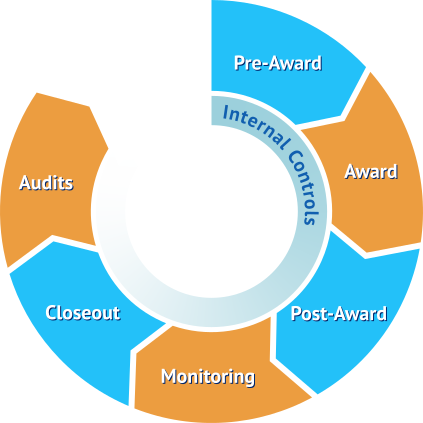
The beginning of the grant lifecycle. This includes reviewing opportunities, submitting applications and reviewing organization capacity.
When the notification is received for the grant award, the terms and conditions are reviewed and the grant is officially accepted.
Involves grant management, oversight, and reporting after funds have been awarded.
A cornerstone step that ensures accountability, compliance, and the successful execution of grant-funded initiatives.
Starts after the end of the period of performance on the grant. Required closeout reports ensure the recipient has met all financial, performance and reporting requirements.
Review of an organization’s financial records, policies, procedures and documentation to ensure adequacy of internal controls and financial statements and grant requirements were followed per the grant agreement.
Traditionally considered pre-award activity, the work performed in this step occurs prior to an award being made. Activities performed in this step include identifying funding opportunities that align with an organization’s mission and goals. Grant writers draft proposals to outline a project’s objectives, budget and potential outcomes with the goal of receiving a grant award. Grant applications require thorough research, a deep understanding of the grantor’s requirements and clear communication.
It is important to note that the tasks and end goals of grant writing are different from grants management.
Grant writing pertains to the necessary steps to secure grant funding.
Grants management occurs after the award has been made and includes the processes of overseeing the projects and activities that must be executed to meet the grant funding goals.
The person who manages the grant should not be the same person who wrote it, and vice versa.
Grants management activities are addressed in numbers 2-5 below
When a grant application is approved, the funding organization (grantor) issues an award to the recipient (grantee). The grant agreement specifies the terms and conditions for utilizing the funds, such as reporting obligations, project timelines and deliverables. It is critical for grants managers to understand all the requirements of a grant award to ensure compliance throughout the grant’s duration.
During this period, grants managers must establish a robust administrative system to support the effective implementation of funded projects. The system includes financial management, cost and expenditure monitoring and allocation, progress reporting, procurement and adherence to grantor guidelines. Additionally, compliance with relevant organization policy, as well as federal, state and local laws, regulations and accounting standards is necessary to maintain transparency and accountability.
Regular monitoring enables organizations to assess the progress of the funded projects against predetermined targets. Grants managers evaluate whether the project is achieving its objectives, utilize funds efficiently and make necessary adjustments if challenges arise. Accurate and timely reporting is crucial to the grantors and the grantee organization to measure the impact of the grant and ensure accountability.
Once a grant period ends, a grants manager must ensure a proper closeout procedure is in place. This involves final reporting, conducting audits, financial reconciliation and providing any required documentation to the grantor.
It is essential for grants managers to build strong relationships with grantors, maintain open communication and fulfill reporting obligations. Maintaining these positive relationships helps ensure a successful project trajectory and is beneficial for securing future funding opportunities.
The five core responsibilities of a grants manager
While every grant is different, the steps in managing a grant from beginning to end are the same. Knowing the steps and what each entails is critical to successful grants management.
Your source for advancement in grants management
Employees working in grants management need a centralized source for training, professional development and community to ensure efficiency, compliance and success. NGMA is that source.
Through NGMA membership, grants professionals have access to live virtual and in-person education, trainings, certification and an expanding and diverse community of fellow grant nerds!
Education path and necessary skillsets
Currently, there are no college degrees directly related to grants management. If you excel in a specific area of grants management or are interested in working in a specific sector, obtaining a related degree or certification(s) can be beneficial to your grants management career.
Examples:
Grants projects potentially impact entire organizations or communities. The responsibilities of a grants manager include managing significant amounts of funding; managing complex projects; complying with multiple rules and regulations and juggling requests, deadlines, meetings and general expectations. They must be able to shoulder a large amount of responsibility, be flexible, be willing to continuously learn and adjust as needed and be prepared to handle the unexpected.
Sought-after skillsets in grants management roles include:
Anyone involved in the management and administration of a grant!
Some organizations have one or more employees fully dedicated to grants management, while smaller organizations may designate the responsibilities of grants management to only one staff member.
In many instances, grants management professionals may have job titles that do not directly reference grants or any part of the grants management process. But whether an employee plays one role, a limited set of roles or every role, they are involved in grants management.
Grants managers work in the following sectors:
Each sector, as well as each individual organization, has unique and specific rules and regulations they must adhere to in grants management. The grants manager needs to know which set of rules should be followed, as oftentimes they differ. This is in addition to the Uniform Guidance and other additional requirements. Compliance education and training is an ongoing and crucial part of successful grants management.
Notable compliance and Uniform Guidance updates
As needed, NGMA holds Compliance Conversations webinars on critical issues affecting the grants community. These webinars helps members ensure they know the latest updates to help keep their grant programs moving forward and compliant.
The Uniform Administrative Requirements, Cost Principles, and Audit Requirements for Federal Awards (commonly called Uniform Guidance) provides an authoritative set of rules and requirements for federal grant awards. NGMA publishes the latest Uniform Guidance updates and supplements available to the public.
Opportunities for new and experienced professionals
Through education, training and involvement in the NGMA community, you can build your career in grants and ensure you have the knowledge, expertise and support you need to succeed.