How Kansas Effectively Distributed Over $1 Billion in CARES Act Funding
It goes without saying that 2020 has presented some serious challenges for state and local governments.

Never before have governments had to navigate the magnitude of funding–over $150 billion from the Coronavirus Relief Fund under the CARES Act– and distribute it in such a short amount of time.

Unlike the typical grants process, where you prepare a plan, indicate how you’re going to spend the money, do the work, and then get reimbursed, the urgent nature of the pandemic has forced governments to account for their spending in the aftermath.

So how can governments efficiently and transparently navigate this unchartered territory?

Learn more in our first-ever Hero Highlight (where we share how inspiring grants leaders and their associated governments innovatively managed their grant funding and delivered incredible impact to their communities).

Through a deliberate and careful process of strategic planning, Cheryl Harrison-Lee, Interim Executive Director of the Recovery Office (and our heroine of this hero highlight) helped the state of Kansas manage over $1.043 billion in CARES Act funding and established a framework that served as a financial reporting template for benchmarks and metrics. Cheryl shares the state of Kansas’ lessons learned and what other governments can do to ensure similar successes of their own.

Establish Community Priorities First

One of the most significant challenges for governments has been determining how and where to spend funding as effectively and efficiently as possible. During her tenure, Cheryl and her team focused on developing strategic priorities revolving around the biggest impacts of the pandemic: health, education, connectivity,  and the economy. Once they analyzed the major impacts of COVID-19, they were able to quickly delineate priorities at the state level and outline priorities at the county level as well.

Having served at the local, city, county, and state level, it was easy for Cheryl to apply her strategic planning and priority-based budgeting expertise that spoke to the needs of a wide variety of communities. Ultimately, the funding addressed healthcare (i.e. more testing) and helping small businesses reopen safely (i.e. PPE and business continuity). The most important distribution method for Cheryl and her team was using the reliable “tier method.”

“We implemented a tier system where the state distributes to the county and the county distributes to the cities,” Cheryl said. “This allows local governments to directly receive their money and work within their communities. Kansas has 103 counties so by staying at the county level, it allowed us to be efficient and expedient.”

This helped save significantly on the timeline of deciding who would get the funding, which would have been exacerbated if Cheryl and her team had to work with every single city and county within Kansas.

Avoid the “Government-Alone” Approach

Given the ever-narrowing timeframe that governments have to incur their CARES Act funding (Dec. 30th being the deadline), the state of Kansas would not have been able to navigate on its own. For Cheryl, bringing in the perspective and voices of stakeholders in the form of a steering committee (which served as a planning advisory committee) and executive committee (which functioned as the recommending body to the Governor and State Finance Council) was crucial.

She and her team sought input from a wide range of public and private-sector stakeholders, including representatives from health, businesses, education, construction, and banking/finance communities. It was especially important that these stakeholders represented many voices. For example, one of the executive board members was the president of the Kansas Hospital Association. Cheryl expressed that without these voices, she and her team would not have been able to access all the ideas that they could as well as ensure everyone had their needs met. For the state of Kansas, it was all hands on deck.

“In a moment of crisis, there’s a heavy lift and that load requires everyone lifting all at once, instead of a government alone approach,” Cheryl said.

Ultimately, by including a diverse group of stakeholders from the beginning, Cheryl and the stakeholder committees were able to help the state get $700 million approved and $400 million of that amount was disbursed within 60 days.

What Governments Need to Do Now Before December 30th

According to Cheryl, it’s especially important that state governments do their utmost now to ensure subrecipient success. She advises that governments take the following steps before the big December deadline:

  • Return funding to the state if you cannot meet the deadline. If counties or local governments have to return any funding, they can return it to states, which can then be added to an unemployment compensation pool or redistribute to entities that have unmet needs. It’s important to send any funding back to states to expand programs they already have in place in alignment with the CARES Act, especially if you are unable to determine where you’re spending funds by the Dec. 30th deadline.
  • Engage your audit firm in advance. Make sure you have your auditors walk through every stage of the grants process with you. This way, as you establish priorities, distribute, and manage funding you know you’re going to meet all your audit requirements in advance. Also, it’s important to document EVERYTHING as you go and have electronic files available.
  • Establish a paper trail with your legal unit. With so many gray areas in the CARES Act, the state of Kansas set up a code interpretation unit with legal counsel so they could track and answer questions as they came up. This also ensured a paper trail was created which showed what decisions were made and how the government arrived at such decisions. Counties could also gain more clarity by being able to ask states about those gray areas and get legal interpretations of eligible expenditures, better ensuring they could justify their spending down the road.

More information > 

eCivis: 6 Takeaways From the Latest Guidance on the American Rescue Plan Act

On March 19, the White House Office of Management and Budget (OMB) issued a memorandum for the heads of executive departments and federal agencies (M-21-20).

This memo was released to give guidance to federal agencies to foster accountability and public trust by delivering effective and equitable relief, while implementing sound financial management of the resources funding that relief. This will include working with the Pandemic Response Accountability Committee (PRAC) and agency Inspector Generals to strengthen payment integrity so governments can minimize the risk of waste, fraud, and abuse. Additionally, the guidance aims to help governments improve the overall award and administration of financial assistance programs with an increased focus on human-centered program and service design to achieve more equitable results.

Reducing Administrative Burden on Funding Recipients

In an attempt to help governments receive and distribute funding faster amidst the urgency of the pandemic, Appendix 3 of the OMB memo gives guidance to agencies on how they can reduce administrative burden on recipients’ performance and deliverables. The guidance applies not only to COVID-19 related awards, but also non-COVID-19 related awards.

The guidance is directed to the executive department and federal agencies by OMB in accordance with Uniform Guidance 2 CFR 200. Agencies may allow these exceptions as they deem appropriate and to the extent permitted by law.

Here are six of the 12 areas of guidance given to federal awarding agencies that will affect recipient awards:

1. Flexibility with SAM/recertification

Federal awarding agencies may relax the timing of the requirement for active SAM registration at time of application to expeditiously issue funding. At the time of award, the requirements of 2 CFR § 200.206, the federal awarding agency’s review of risk posed by applicants continue to apply. Current registrants in SAM with active registrations expiring between April 1, 2021 and September 30, 2021 will automatically be afforded a one-time extension of 180 days.

2. Waiver for Notice of Funding Opportunity (NOFO) Publication

Awarding agencies may publish emergency and competitive NOFOs for grants and cooperative agreements for less than 30 days without separately justifying shortening the timeframe for each NOFO. Recipients, however, will need to monitor funding opportunities and be prepared to compile an application in a shortened amount of time.

3. No-cost extensions on expiring awards

To the extent permitted by law, awarding agencies may extend awards that were active as of March 31, 2021 and scheduled to expire prior or up to December 31, 2021–automatically at no cost for a period of up to 12 months. This will allow time for recipient assessments, the resumption of many individual projects, and a report on program progress and financial status to agency staff. Project-specific financial and performance reports will be due 90 days following the end date of the extension. Awarding agencies will examine the need to extend other project reporting as the need arises. Recipients should contact their awarding agencies for information.

4. Abbreviated non-competitive continuation requests

For non-competitive continuation requests scheduled between April 1, 2021 and December 31, 2021, awarding agencies may accept a brief statement from recipients to verify that they are in a position to: (i) resume or restore their project activities and (ii) accept a planned continuation award. Agencies must post any specific instructions on their website as well as examine the need to extend this approach on subsequent continuation award start dates as recipients have an opportunity to assess the situation.

5. Extension of Single Audit submission

Awarding agencies, in their capacity as cognizant or oversight agencies for audit, should allow recipients and subrecipients that have not yet filed their single audits with the Federal Audit Clearinghouse as of the date of the issuance of this memorandum that have fiscal year-ends through June 30, 2021, to delay the completion and submission of the Single Audit reporting package, as required under Subpart F of 2 CFR § 200.501 to six months beyond the normal due date. Recipients and subrecipients taking advantage of this extension would still qualify as a “low-risk auditee” under the criteria of 2 CFR § 200.520.

Recipients with fiscal year-ends through June 30, 2021, will receive a six-month extension beyond the normal due date to submit to the Federal Audit Clearinghouse. Findings within the six-months after normal due date will not cause the entity to lose their ‘low-risk auditee’ designation.

6. Flexibility with application deadlines

Awarding agencies may provide flexibility with regard to the submission of competing applications in response to specific announcements, as well as unsolicited applications, presuming these exceptions do not negatively impact underserved communities. As appropriate, agencies should list specific guidance on their websites and provide a point of contact for an agency program official.

More information > 

3 Guides and Playbooks

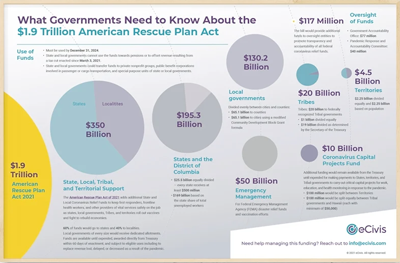
What Governments Need to Know About
the $1.9 Trillion American Rescue Plan Act
Here’s your quick breakdown of how funding will be distributed among state, local, and Tribal governments and Territories

More information > 


_________________________________________________________________________
How States Can Partner With Local
Government to Distribute Relief Funding
State and local governments are receiving the largest amount of grant funding yet that will be channeled to communities, small businesses, and individual citizens. In fact, for the very first time, as much as $60.1 billion will be distributed to cities using a modified Community Development Block Grant (CDBG) program formula. However, to ensure this funding actually has the desired impact in communities, multiple stakeholders must work together, especially when it comes to the timely distribution and management of those funds.

More information > 

_________________________________________________________________________
How to Assemble a Successful
Government Grant Proposal
At eCivis, one of the most frequently asked questions in our community of government professionals is “Is there a template out there for putting together a strong government grant proposal?”

While no single template can address the complex and myriad types of funding opportunities, this playbook can help you get started.

More information >